Why Adaptive Leaders Matter in Today’s World
The rise of AI, remote work, global crises, and generational shifts have made traditional leadership models increasingly obsolete. Today’s most effective leaders aren’t the ones who command and control – they’re the ones who listen, learn, and evolve.
As Ross Thornley puts it in Decoding AQ: Your Greatest Superpower, “Adaptability is not about being reactive – it’s about becoming responsive.” Adaptive leaders navigate complexity with clarity, uncertainty with calm, and change with courage.
In this article, we’ll explore 10 essential characteristics that define adaptive leaders – grounded in the science of the Adaptability Quotient (AQ) and backed by real-world examples across industries.
What Makes a Leader Adaptive?
Understanding Adaptive Leadership
Adaptive leadership is the ability to adjust one’s thinking, behavior, and approach in response to changing conditions – often before others even notice the need. It’s a blend of leadership agility, emotional intelligence, strategic foresight, and the willingness to let go of outdated thinking.
Originally introduced by Ron Heifetz from Harvard, the theory of Adaptive Leadership draws a clear line between:
- Technical challenges, which can be solved with known solutions, and
- Adaptive challenges, which require new learning and shifts in values or behaviors.
This distinction maps closely to AQai’s ACE Model of adaptability:
- Ability – skills and behaviors (like Grit, Unlearning, Mental Flexibility)
- Character – traits and mindset (like Hope, Emotional Range)
- Environment – culture, systems, and conditions that enable adaptability (like Team Support, Work Environment)
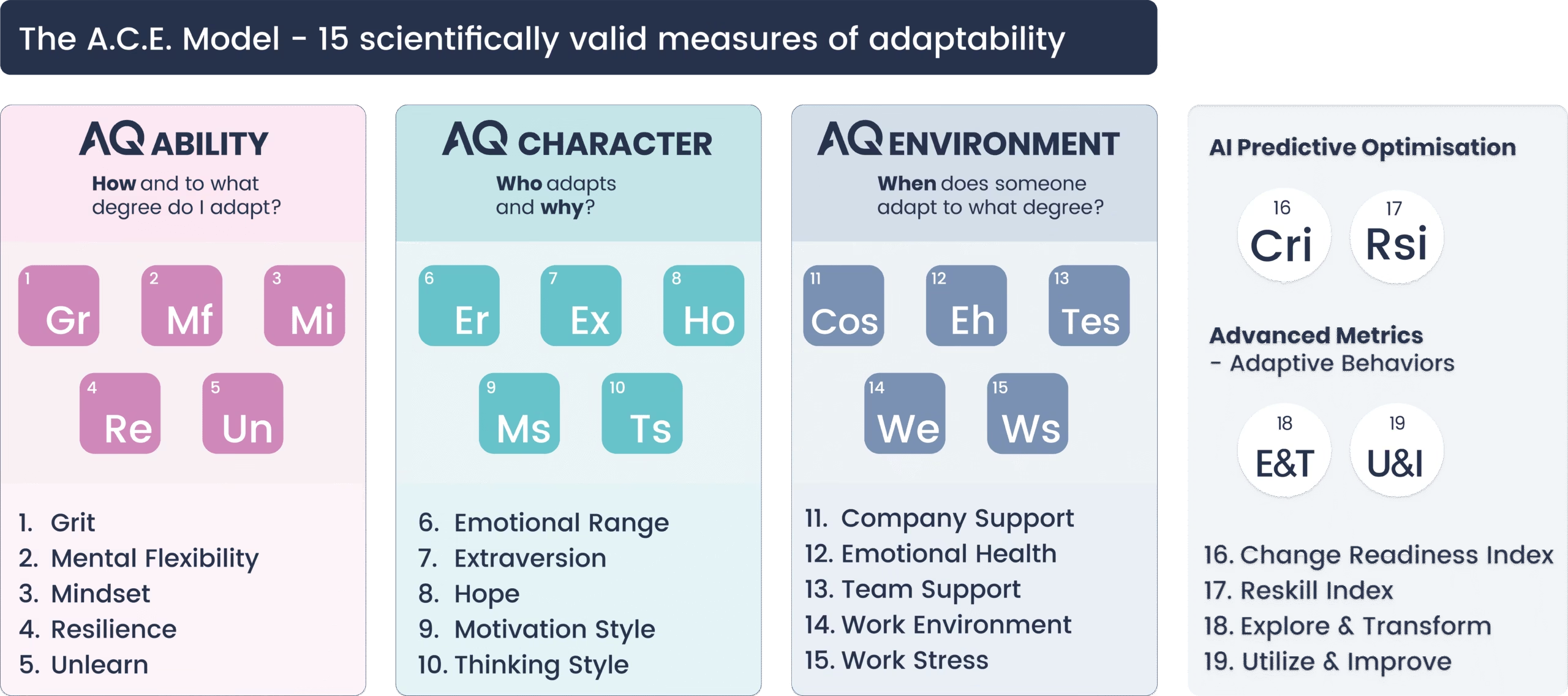
Adaptive leaders excel in all three areas. They stay calm in the chaos and enable others to do the same – not because they have all the answers, but because they know how to keep asking better questions.
Download Sample Report
10 Characteristics of Adaptive Leaders
Adaptive leadership is not one-size-fits-all. It’s a mindset and muscle set, grounded in self-awareness, experimentation, and connection. As we explore the 10 core characteristics that define today’s most adaptive leaders, consider which ones show up in your own leadership – and which ones you’re ready to develop.
1. Learning Agility
Adaptive leaders are not defined by what they know – they are defined by how fast they can learn, unlearn, and relearn. In a world where yesterday’s solutions often become today’s problems, learning agility is the foundation of sustained relevance.
In the AQai model, learning agility is most strongly linked to the Unlearning and Mental Flexibility sub-dimensions:
- Unlearning is the capacity to let go of previously useful knowledge or behaviors that no longer serve the current context.
- Mental Flexibility is the ability to shift between competing ideas, viewpoints, or approaches – often without a clear right answer.
Together, these create a leader who is not wedded to past success, but who treats every challenge as an opportunity to grow and adapt.
As Ross Thornley writes in Decoding AQ, “Adaptability isn’t found in certainty – it’s found in your response to uncertainty. The question is not whether you’re ready, but whether you’re ready to learn”.
Industry Examples
Technology – Reed Hastings (Netflix)
Hastings didn’t just launch a DVD rental company – he dismantled it. Twice.
First, he pivoted Netflix from DVDs to streaming. Then, he turned a distribution company into a content creator. Both moves required abandoning dominant logic and taking calculated risks based on customer behavior and technological shifts.
Aviation – Boeing’s Ed Clark (737 Program Leader)
After technical failures and reputational damage, Boeing needed to rebuild not just its planes but its mindset. Clark led with transparency, instituted new cross-functional learning structures, and prioritized internal knowledge-sharing and systems thinking.
Education – Mary Barra (General Motors CEO)
Barra’s shift to electrification involved abandoning deeply ingrained internal assumptions about what GM was and wasn’t. She invested in learning from software, battery innovation, and user experience – industries far outside GM’s comfort zone.
AQai Integration:
- Unlearning: Lets go of what was successful in the past to make space for better approaches.
- Mental Flexibility: Embraces paradox, opposing viewpoints, and course correction.
- Think Long, Plan Short: Adaptive leaders zoom out to see trends – but zoom in to act today.
Download Sample Report
2. Resilience
Adaptive leaders rely on resilience as their emotional and mental stabilizers. It’s not just the ability to bounce back from adversity, but to bounce forward – growing stronger, wiser, and more grounded with each setback.
In the AQai ACE Model, Resilience is one of the five core sub-dimensions within the Ability category. It measures how quickly someone recovers from difficulties and how effectively they maintain performance and mental clarity during stress.
As Ross Thornley explains in Decoding AQ:
“Resilience isn’t resistance. It’s about flowing through challenge, absorbing the impact, and returning stronger – like a muscle that repairs stronger after strain.”
Why Resilience Matters in Adaptive Leadership
In times of uncertainty, teams don’t just need direction – they need emotional stability. Resilient leaders model calm, compassion, and clarity, even under pressure. This creates psychological safety and gives others permission to pause, reflect, and respond – instead of reacting.
Leaders high in resilience tend to:
- Regulate stress without suppressing emotion
- Recover faster from setbacks or bad decisions
- Stay focused on long-term outcomes
- Normalize failure as part of adaptive growth
Industry Examples
Healthcare – Dr. Paul Farmer (Partners in Health)
Farmer built global health systems in post-disaster zones like Haiti and Rwanda, often facing deep institutional and political challenges. His resilience wasn’t just about pushing forward – it was about staying compassionate, curious, and committed despite extreme adversity.
Aviation – Captain Chesley “Sully” Sullenberger
During the “Miracle on the Hudson” emergency landing, Sully made split-second decisions under enormous stress. Years of preparation and self-regulation helped him remain composed, decisive, and focused on saving lives.
Sports – Serena Williams
Over decades, Serena has battled injuries, loss, public scrutiny, and pregnancy – returning each time with renewed purpose. Her emotional and physical resilience made her not just a champion, but a cultural icon for leadership under pressure.
AQai Model Connections
- Resilience (Ability): Your recovery speed and capacity to stay centered during high-pressure change.
- Work Stress (Environment): Your ability to manage your load, sustain momentum, and avoid burnout.
- Emotional Range (Character): Staying emotionally present without becoming emotionally hijacked.
Download Sample Report
3. Emotional Intelligence
Emotional intelligence (EQ) is a key characteristic of adaptive leaders because change is emotional before it’s strategic. Adaptive leaders understand this deeply – they don’t just manage tasks; they regulate energy, emotion, and empathy across complex human systems.
In the AQai model, Emotional Range is the core sub-dimension that most closely relates to emotional intelligence. It measures how well a person processes emotions and maintains composure during change. Leaders with a high emotional range are often described as emotionally steady, empathetic, and able to support others through ambiguity.
Daniel Goleman, who popularized the concept of EQ, identified adaptability as one of the key emotional competencies:
“Of all the emotional intelligence competencies, strength in adaptability predicts success most often.”
Why EQ Matters in Adaptive Leadership
In unpredictable environments, emotions run high – and people naturally look to leaders for cues. Adaptive leaders don’t pretend to have all the answers. Instead, they:
- Stay calm under pressure without becoming passive
- Acknowledge and name emotions – their own and others’
- Create psychological safety for teams to express concerns or doubts
- De-escalate anxiety through presence and transparency
This is especially important during major transformation projects, layoffs, crises, or cultural shifts, where fear and uncertainty are dominant.
Industry Examples
Politics – Jacinda Ardern (Former Prime Minister of New Zealand)
Ardern’s leadership during the COVID,19 pandemic and the Christchurch terror attack was grounded in compassion, transparency, and vulnerability. She didn’t downplay fear – she helped her country move through it with courage and unity.
AQ traits displayed: Emotional Range, Hope, Team Support
Corporate – Rose Marcario (Former CEO, Patagonia)
Marcario embedded emotional intelligence into the culture of Patagonia, focusing on climate activism, employee well-being, and transparency. She navigated external pressures and internal growth with calm conviction and inclusive dialogue.
AQ traits displayed: Emotional Range, Company Support, Motivation Style
Military – General James Mattis (US Marine Corps)
Known as the “Warrior Monk,” Mattis is deeply intellectual and emotionally self-aware. He emphasized calm under fire and connection with his troops – not just command. His leadership shows how EQ isn’t softness – it’s disciplined strength.
AQ traits displayed: Emotional Range, Mindset, Resilience
AQai Model Connections
- Emotional Range (Character): Staying balanced and responsive, not reactive, when emotions run high
- Team Support (Environment): EQ creates cultures where people feel safe to share, adapt, and contribute
- Mindset (Ability): A positive emotional outlook reinforces the belief that adaptation will lead to growth
Download Sample Report
4. Strategic Foresight
Strategic foresight is the ability to anticipate, prepare for, and shape future realities. While many leaders are skilled at reacting to immediate problems, adaptive leaders distinguish themselves by sensing changes before they arrive – and positioning themselves and their organizations to meet it.
In the AQai ecosystem, strategic foresight is supported by sub-dimensions like Mindset (a belief that the future holds opportunity), Thinking Style (the ability to interpret complex data and systems), and Unlearning (letting go of legacy models in order to move toward more future-fit ones).
As Ross Thornley highlights in Decoding AQ, foresight isn’t about being right about the future – it’s about being ready.
“Strategic foresight isn’t prediction. It’s preparation – the ability to see signals early, test new directions, and act while others are still deciding”.
Why Strategic Foresight Matters in Adaptive Leadership
In an environment shaped by exponential technology, climate volatility, and shifting social values, leaders must develop future literacy. Strategic foresight allows leaders to:
- Identify weak signals and emerging trends
- Think in scenarios, instead of fixed plans
- Balance long-term vision with short-term agility
- Make decisions today that are still valid tomorrow
It’s the bridge between “today’s reality” and “tomorrow’s opportunity.”
Industry Examples
Tech & Innovation – Elon Musk (Tesla, SpaceX)
Love him or loathe him, Musk is a master of foresight. From betting early on EVs to driving the commercial space industry, he takes bold steps before most leaders even accept change is coming. Strategic foresight drives his innovation roadmaps.
AQ traits displayed: Thinking Style, Grit, Unlearning
Energy – Ørsted (formerly Danish Oil and Natural Gas)
Ørsted made a radical pivot from fossil fuels to renewable energy – before the global ESG trend fully matured. The decision to divest from oil and invest in offshore wind required long-term vision and the courage to realign strategy with sustainability.
AQ traits displayed: Mindset, Purpose-driven Adaptability, Company Support
Fashion – Stella McCartney (Sustainable Fashion Pioneer)
McCartney anticipated consumer demand for ethical, cruelty-free, and sustainable fashion long before it became mainstream. Her choices required sacrificing short-term profits for long-term brand integrity.
AQ traits displayed: Strategic Foresight, Hope, Motivation Style
AQai Model Connections
- Mindset (Ability): Belief in positive future outcomes, even amid disruption
- Thinking Style (Character): Big-picture thinking with pattern recognition and scenario planning
- Unlearning (Ability): Willingness to release outdated assumptions to make room for better possibilities
Download Sample Report
5. Grit
Grit is the fierce determination to persist through difficulty – not blindly, but with purpose. It’s the sustained effort over time that turns adaptability from a reactive skill into a proactive superpower.
Psychologist Angela Duckworth, who popularized the term, defines grit as: “Passion and perseverance for long-term goals.”
In the AQai framework, grit is a sub-dimension of Ability, showing how persistently someone pushes through obstacles – even when motivation dips or results are slow. Adaptive leaders with high grit don’t burn out from chasing every trend. Instead, they stick with meaningful goals and adapt the route, not the destination.
Why Grit Matters in Adaptive Leadership
Change is rarely smooth. Transformation takes time, and friction is inevitable. Grit is what helps leaders:
- Stay committed during prolonged uncertainty
- Balance ambition with realism
- Keep teams motivated through the “messy middle”
- Finish what they start – even when conditions change
Grit becomes especially important in adaptive leadership because long-term adaptability depends not only on flexibility, but also on follow-through.
Industry Examples
Entrepreneurship – Sara Blakely (Founder, Spanx)
Blakely faced rejection after rejection from male-dominated investors who didn’t understand her product. But she kept iterating, learning, and refining until Spanx became a billion-dollar brand. Her grit wasn’t just persistence – it was purpose-driven.
AQ traits displayed: Grit, Hope, Motivation Style
Sports – Novak Djokovic
Djokovic has evolved his game, mindset, and training techniques repeatedly to remain at the top of tennis over decades. Even when he’s faced setbacks, controversy, and injury, his commitment to growth and excellence hasn’t wavered.
AQ traits displayed: Grit, Resilience, Learning Agility
Public Health – Dr. Anthony Fauci
Fauci’s decades-long career includes navigating HIV, Ebola, and COVID,19 – with relentless focus and science-based leadership, often under intense scrutiny. His grit lies in his consistency, especially during times of intense political and public pressure.
AQ traits displayed: Grit, Resilience, Emotional Range
AQai Model Connections
- Grit (Ability): Persistence and long-term effort despite setbacks or changing conditions
- Hope (Character): Belief that progress is possible, even when it’s hard
- Work Stress (Environment): Ensuring grit doesn’t overdrive or lead to burnout
Download Sample Report
6. Mental Flexibility
Mental flexibility is the ability to hold multiple, even conflicting, ideas at once – and shift thinking as new data or perspectives emerge. It’s how adaptive leaders avoid becoming trapped in binary thinking, ego attachment, or fixed mental models.
In the AQai model, Mental Flexibility is one of the key sub-dimensions under Ability. It reflects a leader’s openness to ambiguity, paradox, and rethinking – all of which are vital when the “right answer” is no longer obvious or doesn’t exist yet.
This concept aligns closely with Adam Grant’s work in Think Again: “The hallmark of an open mind is not letting go of knowledge. It’s revising your views in light of new evidence.”
Why Mental Flexibility Matters in Adaptive Leadership
Adaptive challenges often require:
- Reframing what the problem even is
- Entertaining multiple possibilities at once
- Testing new hypotheses without ego
- Shifting quickly without feeling like a failure
Mental flexibility helps leaders avoid being “certain and wrong.” Instead, they remain curious and adaptive, asking:
- “What else could be true?”
- “What haven’t we considered?”
- “What if we did the opposite?”
This doesn’t mean indecisiveness – it means dynamic decisiveness.
Industry Examples
Technology – Sundar Pichai (CEO, Google/Alphabet)
Pichai has overseen massive shifts – from hardware and AI to regulatory adaptation and platform ethics. His calm, systems-level thinking reflects mental flexibility, allowing him to lead across diverse business units and complex public scrutiny.
AQ traits displayed: Mental Flexibility, Strategic Foresight, Emotional Range
Healthcare – Atul Gawande (Surgeon, Author, Change Agent)
In both his surgical work and public health policy roles, Gawande balances science, systems, and human behavior. He’s known for questioning assumptions – including his own – and encouraging experimentation in deeply traditional settings.
AQ traits displayed: Mental Flexibility, Unlearning, Thinking Style
Design – Tim Brown (Former CEO, IDEO)
Brown championed “design thinking,” a practice that thrives on ambiguity, iteration, and empathy. Under his leadership, IDEO helped organizations solve problems they didn’t yet know how to define – by shifting mindsets first.
AQ traits displayed: Mental Flexibility, Curiosity, Environment Shaping
AQai Model Connections
- Mental Flexibility (Ability): The ease with which you shift cognitive gears and adapt your mental models
- Unlearning (Ability): Letting go of outdated thinking to make space for new possibilities
- Thinking Style (Character): Systemic, complex, and creative interpretation of data and patterns
Download Sample Report
7. Hope and Optimism
Hope is more than wishful thinking – it’s a grounded belief that better outcomes are possible and worth working toward, even when circumstances are difficult. Adaptive leaders cultivate and project hope as a strategic resource, fueling persistence, resilience, and innovation.
In the AQai Character Dimension, Hope is a critical sub-dimension. It measures how confident a person feels about their ability to shape their future. High-hope individuals are typically better at goal setting, navigating setbacks, and motivating others through uncertainty.
As Martin Seligman, founder of Positive Psychology, notes: “Optimism is invaluable for the meaningful life. With a firm belief in a positive future, you can endure more and achieve more.”
Why Hope and Optimism Matter in Adaptive Leadership
When teams or organizations face major changes – restructures, technological shifts, or external crises – emotions like fear, confusion, and doubt are natural. Adaptive leaders don’t just set direction. They:
- Inspire belief in a meaningful future
- Reframe setbacks as temporary or developmental
- Remind teams why the change matters
- Embody possibility, even amid limitation
Hope doesn’t mean ignoring reality. It means choosing to act toward a better version of it.
Industry Examples
Social Innovation – Muhammad Yunus (Founder, Grameen Bank)
Yunus believed in a hopeful vision where impoverished women could become entrepreneurs through microfinance – a model dismissed by many at the time. He persisted, scaling globally and earning a Nobel Peace Prize.
AQ traits displayed: Hope, Motivation Style, Purpose-Driven Adaptability
Education – Malala Yousafzai
After surviving a Taliban attack, Malala didn’t retreat. She leaned into her message, fueled by unwavering optimism about girls’ education globally. Her leadership combines conviction, clarity, and contagious hope.
AQ traits displayed: Hope, Grit, Emotional Range
Business – Howard Schultz (Starbucks)
When Schultz returned to Starbucks in 2008 during a downturn, he reinvigorated the brand with an emphasis on human connection, ethical sourcing, and global community. His leadership was steeped in optimism about the company’s values and potential.
AQ traits displayed: Hope, Environmental Shaping, Mindset
AQai Model Connections
- Hope (Character): Belief that one’s actions can lead to meaningful change
- Motivation Style (Character): Inner drive to stay engaged toward purposeful goals
- Purpose-Driven Adaptability (Adaptive Insight): Change becomes more sustainable when rooted in meaning
Download Sample Report
8. Inclusivity and Curiosity
Adaptive leaders don’t lead from ego or isolation. They lead with inclusivity and curiosity – seeking diverse inputs, challenging their own assumptions, and creating environments where people feel safe to contribute their full selves.
Inclusivity isn’t just a moral value – it’s a strategic advantage in complex, fast-changing environments. And curiosity is what keeps leaders learning, listening, and evolving.
In the AQai model, this characteristic reflects multiple sub-dimensions:
- Mindset (Ability): An openness to possibility
- Team Support (Environment): Creating trust, dialogue, and psychological safety
- Unlearning and Mental Flexibility: Letting go of being the smartest in the room
As Ross Thornley writes: “Curious leaders ask questions that invite participation, not compliance.”
Why Inclusivity and Curiosity Matter in Adaptive Leadership
No single person can see the full picture in complexity. Inclusive and curious leaders:
- Tap into broader intelligence (across teams, backgrounds, stakeholders)
- Create cultures of innovation and safe challenge
- Attract and retain talent that values contribution over conformity
- Accelerate learning by encouraging experimentation and listening
Adaptability is a team sport – and these leaders ensure everyone’s on the field.
Industry Examples
Tech – Anne Wojcicki (CEO, 23andMe)
Wojcicki democratized genetic information by making science personal and accessible. She fostered cross-disciplinary collaboration between tech, biotech, and healthcare – all driven by customer curiosity.
AQ traits displayed: Curiosity, Thinking Style, Environmental Awareness
Hospitality – Chip Conley (Airbnb’s Modern Elder)
Conley brought emotional intelligence and inclusivity into Airbnb’s culture as it scaled. He listened deeply to younger founders and helped bridge generational wisdom with startup speed – a rare display of humble curiosity.
AQ traits displayed: Mindset, Team Support, Emotional Range
Education – Ken Robinson
Robinson championed creativity and curiosity in education systems that were designed for compliance. His TED Talk became one of the most-watched of all time – not because he had answers, but because he asked bold, inclusive questions.
AQ traits displayed: Curiosity, Unlearning, Purpose-Driven Adaptability
AQai Model Connections
- Mindset (Ability): An openness to explore, not just confirm
- Team Support (Environment): Collaborative culture that empowers dialogue
- Unlearning (Ability): Letting go of hierarchy or positional bias
- Curiosity (Cross-cutting): The engine of continuous adaptation
Download Sample Report
9. Purpose-Driven Adaptability
At its highest level, adaptability isn’t just about reacting to change – it’s about choosing to change in pursuit of a meaningful purpose. Adaptive leaders with clarity of purpose navigate uncertainty more effectively, because they have a guiding north star to align decisions, energy, and communication.
In the AQai model, this concept is embedded in both sub-dimensions and insights:
- Motivation Style (Character): Intrinsic, purpose-oriented drivers over external rewards
- Hope (Character): Belief that meaningful change is possible
- Think Long, Plan Short (Adaptive Insight): Purpose guides the vision, agility guides the execution
Ross Thornley emphasizes: “The most adaptive leaders don’t chase trends – they anchor to purpose and adapt their path to stay aligned with it.”
Why Purpose Matters in Adaptive Leadership
Purpose gives adaptability direction. Without it, change becomes exhausting, scattered, or reactive. Leaders anchored in purpose:
- Make better trade-offs during uncertainty
- Inspire others with a meaningful “why”
- Build cultures of resilience, trust, and long-term thinking
- Are more likely to sustain energy and optimism during long change journeys
Purpose also acts as an internal compass – a filter for what to say “yes” or “no” to.
Industry Examples
Retail – Yvon Chouinard (Founder, Patagonia)
Chouinard famously gave away ownership of Patagonia to a trust that ensures profits support the planet. His entire leadership model was built around the belief that business should serve environmental stewardship – not just profit.
AQ traits displayed: Purpose-Driven Adaptability, Hope, Environmental Shaping
Healthcare – Dr. Devi Shetty (Narayana Health, India)
Dr. Shetty pioneered low-cost heart surgery in India by rethinking the economics of healthcare delivery. His purpose – making life-saving procedures affordable – led to systemic innovation and expanded access for millions.
AQ traits displayed: Motivation Style, Grit, Strategic Foresight
Media – Ava DuVernay (Filmmaker, Advocate)
DuVernay uses storytelling as a vehicle for social justice and representation. Her purpose fuels adaptability – from indie filmmaking to directing major films like Selma and launching platforms like ARRAY for underrepresented voices.
AQ traits displayed: Purpose-Driven Adaptability, Emotional Range, Curiosity
AQai Model Connections
- Motivation Style (Character): Intrinsic purpose over external pressure
- Hope (Character): Belief in meaningful forward momentum
- Strategic Foresight (Ability): Vision with values
- Purpose-Driven Adaptability (Adaptive Insight): Anchoring flexibility in meaningful direction
Download Sample Report
10. Decisive Experimentation
Adaptive leaders don’t wait for perfect plans. They act, learn, and adjust – quickly and intentionally. This final trait, decisive experimentation, is about turning uncertainty into progress through bold, iterative action.
In the AQai framework, this ability draws on several integrated traits:
- Unlearning (Ability): Letting go of perfectionism and “the way it’s always been done”
- Grit (Ability): Staying committed through trial and error
- Thinking Style (Character): Seeing systems, feedback loops, and patterns emerge
- Work Environment (Environment): Psychological safety that encourages risk and learning
Adaptive leaders build learning organizations, where mistakes become data, and innovation is driven by doing – not just discussing.
As Barry O’Reilly says in Unlearn: “You can’t think your way to a new way of acting – you have to act your way to a new way of thinking.”
Why Decisive Experimentation Matters in Adaptive Leadership
In fast-moving environments, speed and feedback are more valuable than slow perfection. Adaptive leaders know that:
- Waiting too long can mean missing opportunity
- Fear of failure leads to stagnation
- Action creates clarity
They make informed bets, learn from results, and shift quickly. Their teams don’t just feel empowered to experiment – they’re expected to.
Industry Examples
Tech – Jeff Bezos (Amazon)
Bezos institutionalized a culture of experimentation at Amazon. From AWS to Kindle to the failed Fire Phone, his mantra was: “Our success is a function of how many experiments we do per year, per month, per week.”
AQ traits displayed: Decisive Experimentation, Thinking Style, Grit
Government – Estonia (Digital Governance)
Estonia became one of the most digitized governments in the world by testing small, citizen-centric tech pilots – not massive overhauls. Their model shows how even bureaucratic systems can be made adaptive through experimentation.
AQ traits displayed: Work Environment, Strategic Foresight, Unlearning
Food Industry – Domino’s Pizza
After years of customer dissatisfaction, Domino’s rebranded, reformulated recipes, and launched transparent marketing campaigns – testing everything from delivery tech to self-critical ads. The company became a turnaround case study in fast, fearless adaptation.
AQ traits displayed: Unlearning, Curiosity, Decisive Experimentation
AQai Model Connections
- Unlearning (Ability): Letting go of rigid plans or outdated beliefs
- Work Environment (Environment): Building trust and safety for bold action
- Thinking Style (Character): Observing results and adapting quickly
- Curiosity: Testing instead of theorizing
Download Sample Report
Conclusion – The Future Belongs to Adaptive Leaders
In a world of exponential change, technical skills expire fast – but adaptability compounds over time. The most effective leaders today aren’t the ones with all the answers. They’re the ones asking better questions, leading with humility, and empowering others to navigate the unknown with confidence.
Here’s a quick recap of the 10 Characteristics of Adaptive Leaders:
- Learning Agility – Fast learners who unlearn even faster
- Resilience – Calm under pressure and quick to recover
- Emotional Intelligence – Empathetic, self-aware, and emotionally present
- Strategic Foresight – Seeing what’s coming and acting ahead
- Grit – Committed to meaningful goals through difficulty
- Mental Flexibility – Holding multiple ideas without getting stuck
- Hope and Optimism – Believing better outcomes are possible
- Inclusivity and Curiosity – Listening widely and thinking expansively
- Purpose-Driven Adaptability – Aligning change with meaningful direction
- Decisive Experimentation – Turning ideas into action without waiting for perfection
Each of these traits can be developed. Your AQ (Adaptability Quotient) isn’t fixed – it’s trainable. And in today’s leadership landscape, building your AQ is no longer optional – it’s essential.
Download Sample Report
Reflection Questions for Readers
Take this into your next leadership meeting, journaling session, or coaching conversation:
- Which of these 10 characteristics do I already express consistently?
- Which one is most underdeveloped for me – and what would help me grow it?
- How can I model adaptability to inspire others on my team?
Next Steps – Adapt Yourself, Then Your Team
- Start small. Choose one trait to develop over the next month.
- Involve others. Share this article in your leadership circle or team Slack.
- Explore deeper. Consider taking an AQme® assessment to measure your Adaptability Quotient and identify areas for growth.
- Facilitate a team reflection. Use these traits as conversation starters during retros, strategy sessions, or change initiatives.
The most adaptive leaders don’t change the world alone – they build environments where everyone can adapt and thrive.
Bring the Adaptability Quotient (AQ) to your organization
At Synergogy, we specialize in helping leaders and teams unlock their Adaptability Quotient (AQ) to navigate uncertainty with confidence, agility, and purpose. Backed by the globally recognized AQai framework, our programs help you unlock measurable, science-based adaptability, right when you need it most.
- Want to assess your team’s AQ profile?
- Looking to run an AQ-powered leadership program or workshop?
- Curious how your organization scores across the ACE model (Ability, Character, Environment)?
Let’s start the conversation.
Email: info@synergogy.com
WhatsApp DM: +971 55 216 0708
🌐 www.synergogy.com
Download Sample Report