Automation Bias: Why Smart Leaders Trust AI Too Much
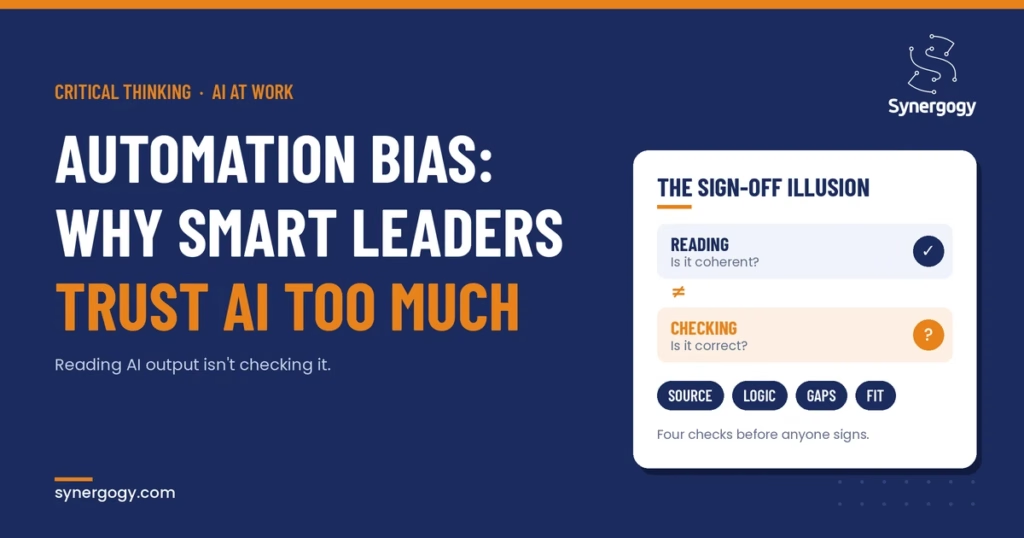
Your team did not check the AI. They signed it. That gap has a name: automation bias. It is the habit of treating a machine’s answer as more reliable than your own judgement. It now sits inside every board paper, hiring shortlist and forecast that passes through a generative AI tool. Automation bias in decision making rarely looks like negligence. It looks like efficiency. This guide answers what is automation bias in plain terms. It walks through automation bias examples from named research. Then it shows how to avoid automation bias without slowing your leadership team down. The goal is simple. Keep the speed of AI, and keep the ownership of every decision.
Key takeaways
- 66% of people rely on AI output without evaluating its accuracy. 56% have made mistakes at work because of AI (University of Melbourne and KPMG, 2025).
- Higher confidence in generative AI predicts less critical thinking, according to Microsoft Research and Carnegie Mellon (CHI 2025).
- On a task outside the AI’s strengths, BCG consultants using AI were 19 percentage points less likely to get it right.
- Automation bias affects experts as well as novices, and instructions alone do not prevent it.
- The way to avoid automation bias is structural: form a view first, run four checks, name an owner and match scrutiny to stakes.
What is automation bias?
Automation bias is the tendency to trust an automated system’s answer over contradictory evidence or your own reasoning. It persists even when the system is wrong. That automation bias definition grew out of aviation and medicine, where decision aids arrived decades before ChatGPT. Early examples of automation bias included pilots following faulty cockpit alerts and clinicians accepting flawed diagnostic prompts.
Researchers Raja Parasuraman and Dietrich Manzey reviewed the evidence in a landmark 2010 paper in Human Factors. They describe two error types. Omission errors happen when people miss a problem because the system never flagged it. Commission errors happen when people follow a flawed recommendation. The review found automation bias in naive and expert users alike. It affected teams as well as individuals. Most strikingly, simple training or instructions did not prevent it.
That matters for every leader approving AI-assisted work. Seniority does not protect you. A memo saying “double-check the AI” will not either. Over-reliance on AI is a flaw in how decisions flow, not a flaw in character.
Why automation bias is rising in leadership teams
Generative AI has moved automation bias from the cockpit to the boardroom. The 2025 Trust, attitudes and use of AI study came from the University of Melbourne with KPMG. It surveyed over 48,000 people across 47 countries. It found that 66% rely on AI output without evaluating its accuracy. Another 56% say they have made mistakes in their work because of AI. Only 47% of employees have received any AI training. Only 40% say their workplace has a policy or guidance on generative AI use.
Microsoft Research and Carnegie Mellon found the same pattern from another angle. Their CHI 2025 study surveyed 319 knowledge workers about 936 real examples of AI use. Higher confidence in generative AI went with less critical thinking. Higher self-confidence went with more. The more people trust the tool, the less they check it. That is automation bias in decision making, measured at work.
Leaders face three accelerants. Speed pressure rewards whoever answers first. Fluent AI prose sounds finished, so it feels verified. And long approval chains spread accountability so thinly that everyone assumes someone else checked. Each one makes it harder to avoid automation bias.
Automation bias in decision making: five places it hides
Automation bias clusters wherever AI output feeds a high-stakes call. These are the most frequent automation bias examples we see in leadership teams.
- Hiring and promotion. AI shortlists look objective, so nobody asks what the model screened out.
- Forecasts and budgets. A confident number anchors the whole discussion, even when its assumptions are thin.
- Performance reviews. AI-drafted feedback sounds balanced, yet it misses context only the manager knows.
- Customer and market analysis. Summaries flatten nuance, and teams act on the summary, not the data.
- Policy and compliance drafts. Fluent text hides gaps only a specialist would catch.
In each case, automation bias in decision-making does not start with laziness. It starts when the AI answer arrives before the human view does. Overcoming automation bias therefore starts with sequence: human view first, AI second.
The root cause: the sign-off illusion
Most organisations believe they already have a safeguard. A human reviews every AI output before it goes anywhere. We call the flaw in that belief the sign-off illusion.
The sign-off illusion is the assumption that reading AI output equals checking it. Reading confirms the output is coherent. Checking confirms it is correct. Those are different tasks, and automation bias quietly swaps one for the other. This is where automation bias in decision making does its quiet damage.
The illusion thrives on three conditions. The reviewer sees the AI answer before forming a view. The reviewer has no defined test to apply. And nobody owns the consequence if the answer is wrong. Remove those three conditions, and trusting AI too much becomes far harder. Breaking this illusion is the core habit we build in our critical thinking for leaders programme.
Rubber-stamp review vs critical review
Here is automation bias explained through five moments of every review.
1. First move
Rubber-stamp: open the AI answer.
Critical: write your own expected answer first.
2. Test applied
Rubber-stamp: “Does it read well?”
Critical: Source, Logic, Gaps and Fit.
3. Ownership
Rubber-stamp: “The tool suggested it.”
Critical: a named person owns the call.
4. Scrutiny level
Rubber-stamp: the same light touch for everything.
Critical: matched to stakes and reversibility.
5. After the decision
Rubber-stamp: no record.
Critical: overrides and errors tracked.
How to avoid automation bias: a five-step routine
If you want to know how to reduce automation bias, start here. These five steps tackle automation bias in decision making. They change the structure of a review, not just its intention.
- Decide before you look. Write a one-line expected answer before you open the AI output. A rough guess works. It anchors your judgement and exposes any gap.
- Run the Four Checks. Test every material output against four questions. Source: where did this come from? Logic: does the reasoning hold? Gaps: what is missing? Fit: does it suit our context? These checks anchor our toolkit for evaluating AI outputs.
- Name a challenger. For any decision above a set threshold, one person argues against the AI recommendation. Rotate the role so it never becomes personal.
- Match scrutiny to stakes. Triage decisions by impact and reversibility. A draft email needs a glance. A restructuring list needs all four checks and a second reviewer. It is the simplest way to avoid automation bias without slowing every decision.
- Track your overrides. Log each time the team rejects or corrects AI output, and why. Over a quarter, the log becomes your library of real automation bias examples. It shows where the tool is weak and where your people stopped looking.
Remember the Parasuraman and Manzey warning. Telling people to be careful is not enough. Preventing automation bias needs habits built into the workflow and practised under realistic pressure. That is why reducing automation bias starts with process design, not posters.
Automation bias examples: a worked case
A simplified automation bias example. A regional HR director in Dubai asks an AI tool to benchmark salaries for a new sales team. The roles span the UAE and Saudi Arabia. The output arrives in seconds, neatly formatted, with confident ranges. She skims it, recognises the job titles and forwards it to finance for budget approval.
Three weeks later, offers start failing. The AI had blended outdated public data with figures from a different industry. Nobody asked the source question. Nobody had a prior number to compare. Finance assumed HR had checked. HR assumed the tool was current.
Now rerun the same case, and automation bias in decision-making loses its grip. She writes her expected range first, based on last year’s hires. The AI figures come back well below it, which triggers the Four Checks. The Source check reveals the age of the data. A challenger from sales leadership flags two roles the model misread. The decision takes forty extra minutes and saves a failed hiring quarter. That is the practical automation bias meaning for any leader: speed without ownership.
Real automation bias examples follow the same shape. Harvard Business School and BCG tested 758 consultants in a field experiment. The researchers picked one business task outside the AI’s strengths. On it, consultants using AI were 19 percentage points less likely to reach the correct answer. The AI made them faster. It also made them wrong. Notice what these examples of automation bias share: speed, fluency and no named owner.
Who owns what: roles that stop over-reliance on AI
Avoiding automation bias is a team sport. Clear roles remove the ambiguity that feeds automation bias in decision making. Each person in the chain needs one job, and each should be able to define automation bias.
- The AI user prepares the output and states which checks they ran.
- The approver forms an independent view first and signs only what they can defend. This is the heart of AI decision making for leaders.
- The challenger argues the opposite case on high-stakes calls.
- HR and L&D build the habit through practice, not policy alone. Spaced Micro Learning Labs™ keep the checks alive after any workshop. They fit inside a wider workplace learning plan.
- The executive sponsor models the behaviour in public. Asking “what did the AI get wrong?” in a meeting signals that scrutiny is welcome.
Managers carry most of the load, because they approve most of the work. Our Coaching Skills for Managers programme helps them ask the questions that surface weak reasoning. Senior teams can embed the same discipline through leadership development and one-to-one executive coaching. Some teams adapt to new checks faster than others, and our Adaptability Quotient assessment shows where to focus. For the technical baseline, our self-paced AI Essentials and AI Business certifications explain how these tools fail. Collect your own automation bias examples in the override log and use them in team reviews.
Seven common mistakes when tackling automation bias
Most efforts at preventing automation bias in decision making stall for one of seven reasons.
- Relying on a policy document. A rule that says “verify AI outputs” changes nothing on a busy Thursday. Staff need automation bias explained through practice, not a PDF.
- Treating seniority as a safeguard. The research shows experts fall for automation bias too.
- Checking only what the AI said. Omission errors hide in what the AI never mentioned. They are the hardest automation bias examples to spot.
- Banning AI on important work. That swaps one bias for another. You avoid automation bias by checking AI, not by removing it.
- Applying the same scrutiny everywhere. Teams burn out and skip checks.
- Making the challenger role personal. Rotate it, or it becomes a career risk nobody accepts.
- Measuring speed, not judgement. People protect whatever you measure, so measure the quality of the call.
Frequently asked questions about automation bias
Automation bias is the tendency to trust an automated system, including AI, over contradictory evidence or your own judgement. It causes two errors: missing problems the system never flagged, and following flawed recommendations. Research shows it affects experts as well as novices.
A manager forwards an AI salary benchmark to finance without checking its data source. The figures are outdated, job offers fail, and nobody owns the error, because each person assumed someone else had checked the output.
Form your own view before reading the AI output. Test it for Source, Logic, Gaps and Fit. Name a challenger for high-stakes calls, match scrutiny to how reversible the decision is, and log every override.
Instructions alone do not. A 2010 review by Parasuraman and Manzey found simple training and instructions failed to prevent it. Practising built-in checks on real decisions, under realistic pressure, works better than awareness sessions.
They overlap but differ. Over-reliance on AI describes the behaviour of leaning on a tool too heavily. Automation bias is the cognitive tendency behind it: giving machine output more weight than contradictory evidence.
Build the habit, not just the policy
Automation bias will not disappear as AI improves. Better tools make decision making more likely, because fluent answers feel more convincing. The leaders who win will keep the speed and keep the ownership.
Our Critical Thinking for Leaders in the Age of AI workshop gives your team the CAIRN Method, the Four Checks and 30 days of follow-through. It shows leaders how to avoid automation bias on their own live decisions. It runs as live critical thinking training online, for cohorts of 12 to 20 leaders, in-house or global. Email info@synergogy.com for dates and a tailored proposal, or get in touch to talk it through.