Home/KPI Certification/KPI-OS™ Code of Practice
KPI-OS™: The KPI Framework and Code of Practice for Key Performance Indicators
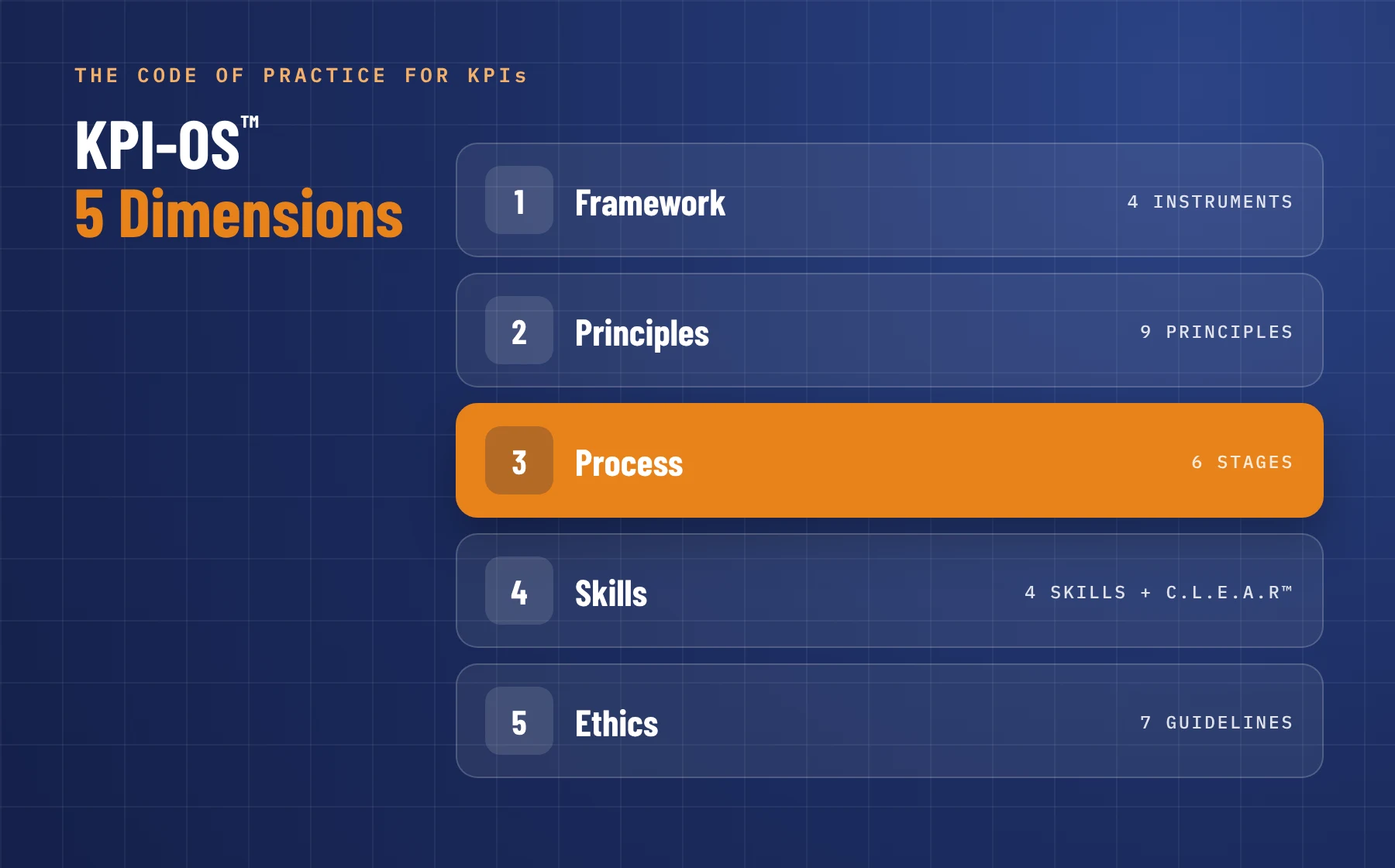
KPI-OS™ codifies how key performance indicators should be chosen, designed, cascaded, reviewed and retired, across five Dimensions: the Framework, the Principles, the Process, the Skills and the Ethical Guidelines.
Created by Nikhil Maini, creator of the OKR-BOK™.
At a glance
KPIs are everywhere. KPI discipline is not.
KPI-OS™ is the Code of Practice for KPIs: a complete KPI framework that defines how key performance indicators should be selected, designed, cascaded, reviewed and retired. It turns scattered KPI best practices into one coherent discipline. It sets the rules for KPI design, the conversations that make KPI cascading work, and the review rhythm and ethics that sustain KPI governance over time. Where most organisations treat measurement as reporting, this KPI framework treats it as the operating system of performance: the discipline that decides what gets measured, who owns it, and what happens when the numbers move.
It is the reference against which every KPI-OS™ credential is taught and assessed, and against which organisations can test their own KPI practice. KPIs may be the most widely adopted instrument in management, and the most widely misused: most KPI portfolios contain too many indicators, too few that matter, almost none that change decisions, and a meaningful number that quietly reward the wrong behaviour.
Dashboards of eighty metrics that look comprehensive and change nothing.
Targets met by behaviour nobody intended: Goodhart's Law in action.
Indicators with no line of sight to strategy and no owner who acts on them.
Meetings where numbers are presented and nothing is decided.
What KPI-OS™ is: a complete KPI framework covering structure, standards, lifecycle, skills and ethics; a living code of practice, reviewed annually; compatible with every dashboard, BI and performance platform.
What it is not: software, despite the name (the operating system is human, not digital); a template library; or a method tied to one sector, country or scorecard.
The KPI Framework: One Architecture, Five Dimensions
KPI-OS™ is organised around five Dimensions. Each answers a distinct question of practice; together they cover the whole territory of KPI work.
What is the structural blueprint of a KPI?
4 instrumentsWhat standards govern KPI design?
9 principlesHow does KPI work flow?
6 stagesWhat does a practitioner actually do?
4 skills + C.L.E.A.R™To what does a certificant commit?
7 guidelinesThe order is deliberate. The Framework establishes structure; the Principles fill it; the Process sequences both into practice; the Skills make the Process run, because KPIs do not implement themselves; and the Ethical Guidelines are the floor. A practitioner fluent in the KPI framework but ethically untethered is a danger to the organisations they serve.
The four KPI framework instruments
The first Dimension gives every KPI framework built under KPI-OS™ the same structural blueprint.
Strategy-Measurement Map™
Answers the question every dashboard skips: what should be measured, and why? It translates Vision, Strategy and a single North Star into five to nine Strategic KPIs, then into the Operational KPIs that support them. A strategy that cannot be measured is a strategy that needs sharpening.
5-Layer KPI Cascade™
The vertical architecture through which KPIs legitimately cascade. Cascade is intent translation, not arithmetic distribution.
KPI Anatomy Canvas™
The ten components every KPI must specify before deployment, from definition and formula to polarity, owner and decision trigger. It distinguishes a KPI from an aspiration, and is covered in detail under KPI design below.
Performance Lens Quintet™
A five-lens balance check: Financial; Customer & Stakeholder; Internal Process & Operations; Learning, Growth & People; and Sustainability & Stewardship. A portfolio with no KPIs in a lens almost always reveals an under-articulated strategy in that domain.
KPI Best Practices: The Nine Principles
The nine Principles are the craftsmanship standards of the KPI framework. Each states what it requires and names the failure mode it prevents.
KPIs are chosen for strategic significance, not because the data already exists.
Guards against: measurement conveniencePortfolios weight results and impact above activity counts.
Guards against: activity worshipEvery portfolio mixes predictive and confirmatory indicators.
Guards against: late detectionEvery KPI has one named, accountable owner, never a team or department.
Guards against: diffused accountabilityEvery KPI traces upward to strategy and downward to action.
Guards against: orphan KPIsOne defined data source per KPI, automated wherever possible.
Guards against: scorecard proliferationA defined cadence, owner, format and decision rights, honoured every cycle.
Guards against: measurement abandonmentEvery KPI is stress-tested for perverse incentives before it goes live.
Guards against: KPI gamingThe portfolio is curated, not accumulated. KPIs have lifecycles.
Guards against: portfolio bloatThese KPI best practices are deliberately few, so they stay memorable and enforceable. They are also the audit criteria in Stage 6 of the Process, so the standards that shape a KPI at design time are used to judge it a year later.
KPI Design: The Anatomy Canvas™ and the C.L.E.A.R™ Test
Good KPI design starts with a complete specification and ends with a stress test. Under the KPI framework, a KPI missing any of the ten components below is incomplete and not ready for deployment.
The ten components of the Canvas
Why Polarity and Decision Trigger matter
Most KPI templates stop at formula and target. Two components turn the Canvas into a genuine KPI design instrument rather than a documentation form.
Polarity forces the designer to declare which direction is good. That matters for KPIs such as inventory days or staff turnover, where too low can be as harmful as too high.
Decision Trigger forces the designer to agree in advance what will happen when the number moves. If nothing would happen, the indicator is reporting, not managing.
The difference in practice
The C.L.E.A.R™ test
Every KPI is stress-tested against five criteria at design, at cascade, at review and at audit. A KPI that fails any one is flagged for redesign or retirement.
Traces upward to strategy and downward to action through the Cascade.
Declares its type and names its counterpart, so the portfolio can be balanced.
Resists gaming and protects good stewardship behaviour.
Carries a decision trigger. If nothing happens when it moves, retire it.
Has a defined rhythm, owner and decision rights.
KPI Cascading: The Six-Stage Process and Four Skills
KPI cascading is where most measurement systems quietly fail. The KPI-OS™ Process sequences the work across six stages, and four signature skills make each stage work in practice.
Strategic Alignment
Translate vision and strategy into measurable intent. Output: the Strategy-Measurement Map™.
KPI Design
Generate candidates, balance the lenses, stress-test with C.L.E.A.R™, document on the Canvas.
Cascading & Communication
Deploy across the five layers through facilitated conversations, not memos.
Measurement Infrastructure
Map sources, close gaps, automate and build decision-first dashboards.
Review, Calibration & Action
Run the monthly and quarterly rhythm, recalibrate honestly and record decisions.
Governance, Audit & Improvement
Audit the portfolio annually; retire, refine and add.
Where KPI practice most often breaks
Across hundreds of organisations, the Process breaks at three points: at Stage 2, when KPIs are documented without being stress-tested; at Stage 3, when KPI cascading happens by memo, producing nominal ownership instead of real ownership; and at Stage 6, which most organisations never run. That omission is the single largest cause of long-run portfolio decay.
Four skills that make the Process run
The skills distinguish a KPI-OS™ practitioner from an analyst or a generic consultant. They are taught and, at Certified Professional level, assessed live.
Reading what a KPI portfolio actually says, as distinct from what people claim it says. An analyst reads numbers; a sense-maker reads meaning, detects gaming and separates signal from noise.
The structured conversation that carries a KPI from one layer to the next without distortion or political compromise. It is the skill that turns KPI cascading from imposition into ownership.
Helping owners adjust targets or definitions when context genuinely changes, without inviting gaming or rewarding underperformance. Calibration is sometimes legitimate; gaming never is.
Turning KPI data into board-ready narratives that surface decisions rather than present data. Numbers do not drive decisions; narratives do.
KPI Governance: The Seven Ethical Guidelines
KPI governance is more than an annual audit. Because measurement shapes behaviour, the KPI framework sets a moral floor that every certificant commits to as a condition of certification.
Never distort, hide or fabricate KPI data, even under pressure.
Refuse to design KPIs that foreseeably incentivise harm.
Present the same KPI the same way to boards, regulators, customers and the public.
Protect sensitive performance data within and beyond the engagement.
Comparable performance produces comparable consequences.
Actively resist gaming, vanity metrics and measurement theatre, and raise them when seen.
Disclose the limitations of every KPI to the people who decide on it.
In practice, KPI governance combines these commitments with Stage 6 of the Process: a yearly audit of every KPI against the nine Principles and C.L.E.A.R™, with clear retire, refine and add recommendations. Foundation certificants sign the Practitioner Pledge; Certified Professionals sign the Professional Pledge.
The KPI-OS™ Certification Ladder
KPI-OS™ is delivered through a progressive ladder. Each level raises the cognitive bar, not merely the volume of content. See the full KPI certification pathway.
KPI-OS™ Foundation
Fluency in the KPI framework, its Principles, Process and vocabulary, applying C.L.E.A.R™ to your own KPIs.
KPI-OS™ Certified Professional
Applied capability to design, cascade, govern and narrate KPIs for a function or business unit.
KPI-OS™ Certified Architect
Architecting the measurement function for a whole organisation: the pathway to Chief KPI Officer.
The Foundation is the gateway: it is required pre-work for the KPI-OS™ Certified Professional, and its fee is creditable towards it. Synergogy is pursuing recertification credit with the HR Certification Institute (HRCI); status will be published here once granted.
One family: OKR-BOK™ and KPI-OS™
KPI-OS™ is the sister discipline of the OKR-BOK™, published by OKR International. OKR-BOK™ is the Body of Knowledge for OKRs; KPI-OS™ is the Code of Practice for KPIs. KPIs measure where we are; OKRs declare where we are going. Mature organisations run both, and Synergogy also delivers OKR implementation.
KPI-OS™, asked straight
What is KPI-OS™?
KPI-OS™ is the Code of Practice for KPIs, created by Nikhil Maini and maintained by Synergogy. It is a complete KPI framework organised around five Dimensions: the Framework, the Principles, the Process, the Skills and the Ethical Guidelines. It is the reference against which KPI-OS™ credentials are taught and assessed.
What is a KPI framework?
A KPI framework is a structured approach for selecting, defining, cascading, reviewing and retiring key performance indicators so that they connect strategy to decisions. A strong KPI framework specifies what to measure and why, how each KPI is documented, who owns it, how often it is reviewed, and what action follows when it moves.
What are the five Dimensions of KPI-OS™?
The five Dimensions are the KPI Framework (four structural instruments), the nine Principles, the six-stage Process, the four signature Skills with the C.L.E.A.R™ diagnostic, and the seven Ethical Guidelines. Together they cover structure, standards, lifecycle, competence and conduct.
What are the most important KPI best practices?
KPI-OS™ sets out nine KPI best practices: choose KPIs for significance over convenience, favour outcomes over outputs, balance leading and lagging indicators, give every KPI one named owner, keep line-of-sight to strategy, use a single source of truth, review in rhythm, stress-test for gaming, and retire KPIs when they have served their purpose.
What is the C.L.E.A.R™ model in KPI design?
C.L.E.A.R™ is the KPI-OS™ diagnostic for KPI design. Every KPI must be Connected to strategy and action, declare whether it is Leading or Lagging and name its counterpart, be Ethical and resistant to gaming, be Actionable with a decision trigger, and be Reviewed on a defined rhythm with a named owner. A KPI that fails any test is redesigned or retired.
How does KPI cascading work under KPI-OS™?
KPI cascading under KPI-OS™ moves KPIs through five layers: Ecosystem, Entity, Function, Team and Individual. Each handover is made through a structured Cascade Conversation™ rather than a memo, so that intent is translated rather than imposed and every owner understands what is asked of them and why.
What does KPI governance involve?
KPI governance under KPI-OS™ combines an annual audit of every KPI against the nine Principles and C.L.E.A.R™ with seven Ethical Guidelines, including measurement integrity, refusal to game and continuous disclosure of each KPI's limitations to decision-makers.
How do I get KPI-OS™ certified?
Start with KPI-OS™ Foundation, a self-paced credential that builds fluency in the code of practice. Then progress to KPI-OS™ Certified Professional, a six-week blended programme assessed by exam, portfolio and a recorded skills demonstration. KPI-OS™ Certified Architect will follow later for enterprise-scale practitioners.
How is KPI-OS™ related to OKR-BOK™?
KPI-OS™ and OKR-BOK™ are sister disciplines created by Nikhil Maini and share the same five-Dimension architecture. OKR-BOK™ is the Body of Knowledge for OKRs, which set ambitious time-bound goals; KPI-OS™ is the Code of Practice for KPIs, which measure ongoing performance. Mature organisations use both.
Build KPI capability on a proven code of practice
Managing Director, Synergogy · Founder & CEO, OKR International · Creator of OKR-BOK™, Micro-OKRs™ and KPI-OS™
- Creator-led: taught by the team that wrote the KPI framework, not a reseller reading from slides.
- Practice-assessed: portfolios on your own unit and live skills demonstrations, judged against a published rubric.
- KPIs and OKRs, together: designed as the sister of an OKR body of knowledge, with integration built in.
- Behaviour, not templates: four signature skills for the conversations that make measurement work.
- Sector-neutral: applied with equal rigour in government, finance, healthcare, energy, technology and family business.
In-house / UAE & Globally
Synergogy maintains the KPI-OS™ Code of Practice, certifies practitioners against it, and runs in-house KPI framework programmes online and in person.
Bring KPI-OS™ to your organisation
Certify your people, run an in-house KPI framework programme, or audit your current KPI portfolio against the code of practice. Talk to Synergogy.
KPI-OS™, C.L.E.A.R™, Strategy-Measurement Map™, 5-Layer KPI Cascade™, KPI Anatomy Canvas™, Performance Lens Quintet™, Indicator Sense-Making™, Cascade Conversations™, Calibration Coaching™ and Performance Narrative Crafting™ are trademarks of Synergogy. OKR-BOK™ and Micro-OKRs™ are trademarks of OKR International. © 2026 Synergogy.