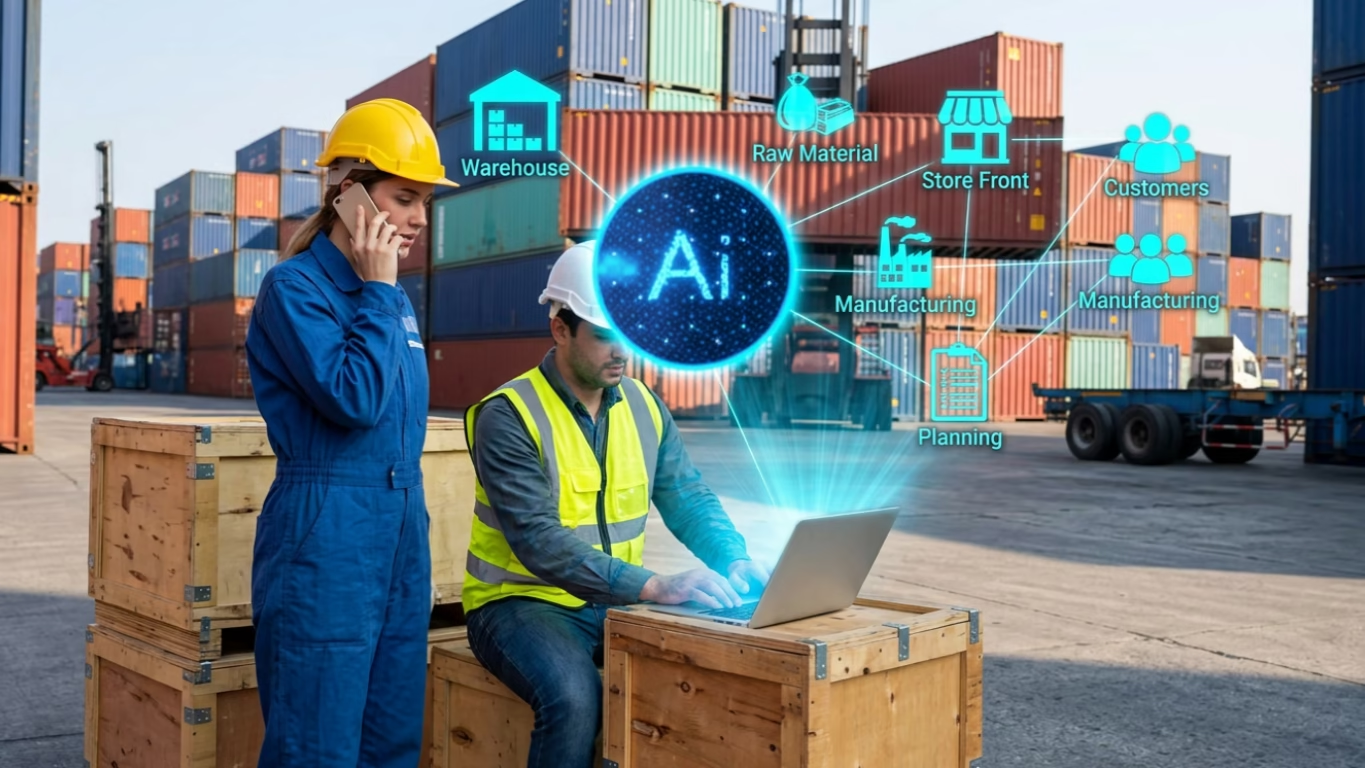
Supply chains used to react. Now they anticipate. AI in supply chain operations has moved from pilot projects to production, powering demand forecasting, inventory optimization, and logistics planning that runs with growing autonomy. This guide shows supply chain, logistics, and procurement professionals across India and worldwide how AI-driven forecasting and predictive analytics actually work, why no coding is required, and how a supply chain AI certification puts you ahead. For enterprises handling supplier and customer data under laws like the DPDP Act, adopting AI responsibly is now essential. Let’s look at what “autonomous” really means.
Key Takeaways
- AI in supply chain has transformed operations through demand forecasting, inventory optimization, and logistics planning.
- An autonomous supply chain continuously makes routine decisions using AI, while humans focus on strategy and critical judgment.
- AI improves supply chain efficiency by predicting demand, optimizing inventory, and responding to disruptions proactively.
- No coding skills are needed to implement AI in supply chains; professionals can use user-friendly platforms instead.
- Achieving a supply chain AI certification enhances career prospects by providing structured learning and recognized credentials.
What Is AI in Supply Chain?
AI in supply chain is the use of artificial intelligence to forecast demand, optimize inventory, plan logistics, and support decisions across procurement and operations. Specifically, AI reads signals across your network — sales, suppliers, weather, transit times — and recommends or executes actions, while supply chain professionals set the strategy and make the judgment calls.
What “Autonomous” Actually Means in 2026
Let’s be precise, because the term gets oversold. An autonomous supply chain doesn’t mean nobody is in charge. Rather, it means routine decisions now happen continuously and automatically, without waiting for a weekly planning meeting.
In practice, AI senses demand shifts and updates forecasts daily. It triggers replenishment before stockouts occur. It reroutes shipments when a port backs up. Meanwhile, humans handle supplier negotiations, crisis response, and the trade-offs that require accountability.
Snippet-ready answer: An autonomous supply chain uses AI to sense demand, forecast, replenish inventory, and adjust logistics continuously and automatically — while humans set strategy, manage supplier relationships, and own high-stakes decisions.
That’s why structured programs like Synergogy’s AI Business certification track are in rising demand across logistics and operations teams.
Where AI Delivers Value Across the Supply Chain
AI touches nearly every link in the chain. Here’s where it delivers the biggest wins:
- Demand forecasting — predict what customers will want, and when.
- Inventory optimization — hold less stock while avoiding stockouts.
- Logistics planning — optimize routes, loads, and delivery performance.
- Procurement intelligence — evaluate suppliers and anticipate cost shifts.
- Predictive analytics — spot disruptions before they hit your network.
- Production planning — improve capacity utilization and scheduling.
- Generative AI strategy — model scenarios and stress-test plans quickly.
Notice the theme: AI handles the sensing and the number-crunching, so professionals focus on strategy, relationships, and resilience.
From Reactive to Predictive: The Real Shift
Traditional supply chains discover problems after they happen. A stockout appears on a report. A delay surfaces when the truck doesn’t arrive. By then, the cost is already incurred.
Predictive supply chains work the other way around. AI reads early signals — order patterns, supplier performance, transit anomalies — and flags risk before it becomes disruption. Consequently, teams act days or weeks earlier, which is where most of the savings actually come from.
For volatile, fast-growing markets like India’s, moreover, this shift is decisive. Disruption is constant, and the organizations that sense it earliest protect both service levels and margins.
No Coding Required — Just Supply Chain Insight
Here’s the reassuring part. You don’t need to be technical to lead AI in supply chain, because these tools are built for operators, not engineers.
In practice, AI supply chain platforms work through familiar dashboards and planning systems. The AI runs in the background; you interpret the recommendations and apply your operational knowledge. Enterprise tools like C3.ai are designed for exactly this kind of business user.
To be clear, no advanced technical or coding background is required. A basic understanding of supply chain concepts is helpful, and the rest is learnable. So if you’re a supply chain professional, logistics or operations manager, procurement specialist, or business leader, this skill set is fully within reach.
🚀 Ready to lead an AI-driven supply chain? Build practical, no-code skills with Synergogy’s AI certification programs at your own pace.
The Human Judgment Autonomy Still Needs
This is where good leaders stay grounded. AI optimizes within the rules you give it. However, it doesn’t understand context the way you do.
An algorithm can reroute a shipment, but it can’t weigh a decade-long supplier relationship. It can recommend the cheapest source, but it can’t judge ethical sourcing, labour standards, or reputational risk. It can optimize for cost, yet miss the strategic reason you keep a second supplier on standby.
Therefore, responsible adoption keeps humans accountable for consequential decisions. AI handles the continuous, routine optimization; leaders own strategy, ethics, and the calls that carry real consequences. Understanding that boundary is exactly what separates an AI-ready supply chain leader from someone simply buying software.
Data, Ethics, and Compliance in AI Supply Chains
Here’s where responsible teams stand apart. Supply chain AI runs on data from suppliers, customers, and partners — so governance is non-negotiable.
Data Quality and Transparency
First, AI is only as good as its inputs. Poor data produces confident but wrong forecasts, so validating data quality matters as much as choosing tools. In addition, teams should understand why AI made a recommendation, especially when it affects suppliers or pricing.
Privacy and Regulatory Compliance
Second, protect the data itself. Enterprises must respect India’s DPDP Act, the GDPR for European partners, and CCPA in California. Moreover, security standards like ISO 27001 govern how supplier and customer data is stored and shared across the network.
Strong AI governance ties it together — keeping AI fair, transparent, and accountable across the full compliance lifecycle, from data collection and consent through use, storage, and deletion.
Responsible AI supply chain checklist:
- Validate your data — bad inputs produce confidently wrong decisions.
- Protect partner data — follow DPDP, GDPR, CCPA, and ISO 27001 standards.
- Demand transparency — understand why AI recommends what it recommends.
- Keep humans accountable — leaders own supplier, ethical, and crisis decisions.
Ultimately, responsible practice builds resilience — and resilience is what supply chains are really for.
Traditional Supply Chain vs. AI-Driven Supply Chain
| Factor | Traditional Supply Chain | AI-Driven Supply Chain |
|---|---|---|
| Forecasting | Historical averages | Predictive, signal-based |
| Planning cycle | Weekly or monthly | Continuous |
| Inventory | Buffer stock everywhere | Optimized to real demand |
| Disruptions | Discovered late | Flagged early |
| Logistics | Fixed routes | Dynamically optimized |
| Coding needed? | No | No |
The takeaway is simple. AI doesn’t replace supply chain professionals — instead, it gives them foresight, speed, and precision, while people stay firmly in charge of strategy and relationships.
Why Get a Supply Chain AI Certification
You can experiment with tools alone. However, a structured, industry-specific certification is faster, deeper, and far more credible to employers.
A strong supply chain AI certification gives you three things. First, structure — forecasting, inventory, logistics, and digitization taught in the right order. Second, proof — a globally recognized credential that signals real capability. Third, applied practice — real case studies and a hands-on workshop, not just theory.
The AI+ Supply Chain Practitioner™ certification, delivered by Synergogy as an Authorized Training Partner of AI CERTs®, is built for exactly this. Designed for supply chain, logistics, procurement, and operations professionals, it requires no advanced technical background and covers AI-driven demand forecasting, inventory optimization, logistics planning, predictive analytics, supply chain digitization, generative AI strategy, and industry-specific applications — plus a hands-on workshop on real supply chain challenges. Explore the full range in Synergogy’s AI certification catalog.
🎓 Lead the shift. Enroll in the AI+ Supply Chain Practitioner™ certification and drive AI-powered supply chain performance.
How to Bring AI to Your Supply Chain in 7 Steps
- Learn the fundamentals.
First, understand how AI applies to forecasting, inventory, and logistics — no coding.
- Fix your data foundation.
Next, audit data quality, because AI amplifies whatever you feed it.
- Start with demand forecasting.
Then apply AI where the ROI is clearest and easiest to measure.
- Optimize inventory.
Use AI to cut excess stock while protecting service levels.
- Extend into logistics.
After that, apply AI to routing, load planning, and delivery performance.
- Govern responsibly.
Meanwhile, protect partner data and follow DPDP, GDPR, CCPA, and ISO 27001.
- Get certified.
Finally, earn a supply chain AI certification to prove your skills and lead adoption.
FAQ
AI in supply chain is the use of artificial intelligence to forecast demand, optimize inventory, plan logistics, and support procurement and operations decisions. Specifically, AI reads signals across the network — sales, suppliers, weather, transit times — and recommends or executes actions. It matters because supply chains face constant volatility and cost pressure. As a result, organizations that sense disruption earliest protect both service levels and margins, making AI capability a strategic advantage rather than a technical add-on.
It means routine decisions happen continuously and automatically, rather than waiting for a weekly planning cycle. In practice, AI senses demand shifts and updates forecasts daily, triggers replenishment before stockouts, and reroutes shipments when disruptions occur. However, autonomy is partial, not total. Humans still handle supplier negotiations, crisis response, ethical sourcing, and decisions that carry real accountability. The best results come from AI running the routine optimization while experienced leaders own strategy and judgment.
Traditional forecasting leans on historical averages, which struggle when conditions shift. AI instead reads many signals at once — order patterns, seasonality, promotions, supplier performance, even external factors — and updates predictions continuously. Consequently, forecasts get sharper and react faster. On the inventory side, better forecasts mean you can hold less buffer stock while still avoiding stockouts. That combination frees working capital and improves service levels simultaneously, which is where much of AI’s supply chain ROI comes from.
For most supply chain and logistics professionals, yes. A structured supply chain AI certification gives you an industry-specific learning path — forecasting, inventory, logistics, digitization, and generative AI strategy in the right order — plus a globally recognized credential and hands-on practice with real case studies. As organizations invest in AI-capable teams, certified professionals stand out and advance into roles like supply chain strategist, planning lead, and operations transformation manager. Because it requires no coding, it’s an accessible, high-leverage career move.
Latest Blogs
- Workforce Planning Tools and Frameworks: A Practical Guide with Examples
- How to Create a RACI Matrix: 7 Steps, Example and Template
- Hiring Is Broken: The Behavioural Interviewing Questions That Fix It When Every CV Is AI-Polished
- Fractional CHRO Cost in the UAE: The Complete 2026 Pricing Guide
- UAE Emiratisation Compliance Guide 2026–27: Targets, Fines, Nafis and How to Stay Ahead