KPI Maturity Model: Where Does Your Organisation Stand, and How Do You Move Up?
Two organisations can track the same indicators and get completely different results. One steers by its numbers; the other merely reports them. The gap is maturity, and a KPI maturity model makes it visible. This guide gives you a practical one. First, it defines the five KPI maturity levels and what each looks like day to day. Next, it explains what performance measurement maturity actually measures — not the quality of your dashboard but the quality of your management habits. Then it provides a twelve-statement KPI maturity assessment you can complete in twenty minutes. Finally, it shows how to improve KPI maturity one level at a time, drawing on the approach Synergogy uses with organisations across the UAE, India and worldwide. Moreover, if you would rather have the assessment run independently, our KPI implementation services begin with exactly that.
KPI Maturity Model: A Working Definition
A KPI maturity model is a staged framework that describes how an organisation’s use of performance indicators develops — from ad hoc numbers in spreadsheets to an embedded management routine that shapes decisions at every level. Each stage has observable characteristics, so leaders can locate themselves honestly and see what the next stage requires.
The idea borrows from the Capability Maturity Model developed for software engineering, which showed that capability improves in recognisable steps rather than all at once. Applied to measurement, a maturity model answers two questions: where are we now, and what should we fix first? Consequently, it is a diagnostic tool before it is anything else.
What Performance Measurement Maturity Really Measures
Performance measurement maturity is often mistaken for technical sophistication. It is not, and that misunderstanding explains why so many dashboard projects leave measurement maturity exactly where it was. An organisation with a live, automated dashboard can be less mature than one with a monthly spreadsheet, if the spreadsheet drives decisions and the dashboard does not.
Instead, performance measurement maturity describes six capabilities that together turn numbers into management:
- Strategic alignment — indicators derive from stated objectives.
- Indicator quality — each measure has a definition, owner, target and decision trigger.
- Cascade — measures connect coherently from entity to team.
- Data and infrastructure — one trusted source per indicator, delivered on time.
- Review and calibration — scheduled conversations that end in decisions.
- Portfolio stewardship — indicators are added, refined and retired deliberately.
These six capabilities mirror the six stages of Synergogy’s implementation approach, which is no coincidence: maturity grows in the same order that a sound implementation proceeds. Therefore, the KPI maturity model below rates all six, not just the visible ones.
The Five KPI Maturity Levels
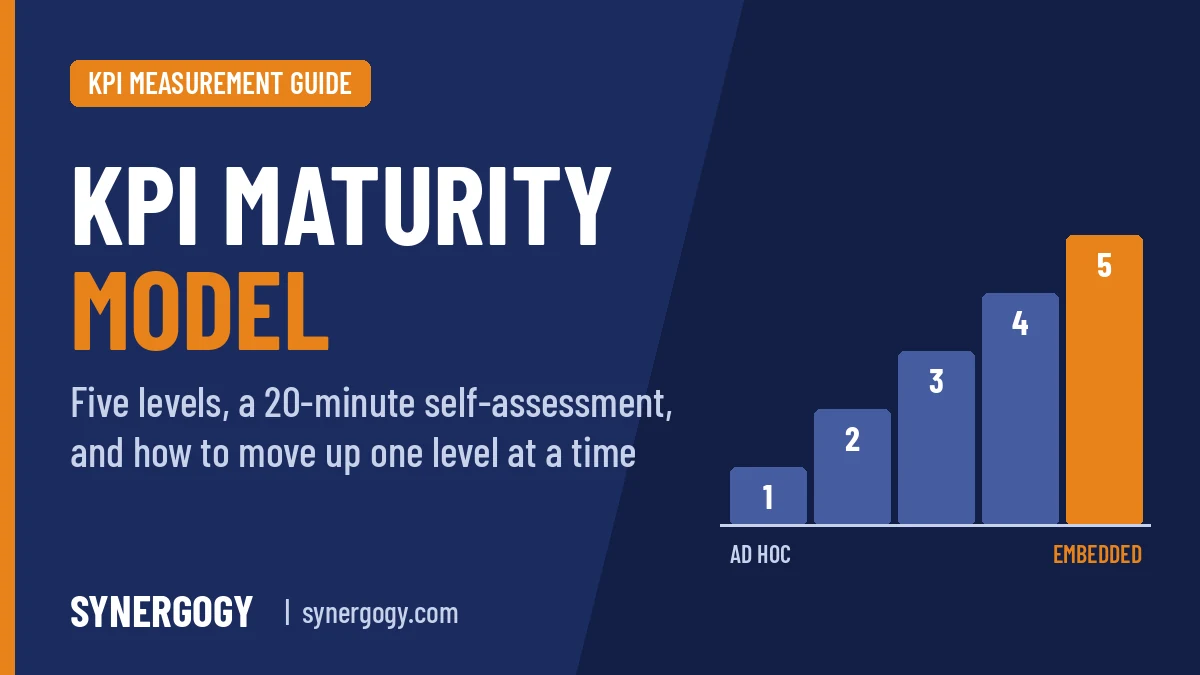
Most organisations sit at level two or three on any KPI maturity model. Here are the five KPI maturity levels, with the signs that tell you which one describes your organisation.
Level 1 — Ad hoc. Numbers exist in spreadsheets and inboxes. Nobody owns them, definitions vary by department, and leadership meetings rely on anecdote. Sign: two managers quote two different figures for the same thing.
Level 2 — Reporting. A regular report or dashboard exists. However, it lists what is easy to count, carries dozens of lines, and is presented rather than discussed. Sign: monthly reviews end with updates, not actions.
Level 3 — Managed. A short set of indicators is tied to objectives, each has an owner and a target, and monthly reviews happen. Nevertheless, teams below the top level still track their own numbers, and data disputes persist. Sign: the executive team is aligned, but departments are not.
Level 4 — Aligned. Indicators cascade coherently, one data source serves each measure, and leading indicators sit beside lagging ones. Reviews produce decisions, and owners arrive with proposals. Sign: a red indicator triggers action before anyone asks.
Level 5 — Embedded. Measurement is simply how the organisation manages. Indicators are retired and renewed annually, people report bad news early, and the system survives leadership changes. Sign: nobody calls it “the KPI project” any more.
Notably, the KPI maturity levels are cumulative, and performance measurement maturity builds in the same order. An organisation cannot skip from two to four, because level four depends on the ownership and review habits built at level three. In addition, maturity can fall: a reorganisation or a new leadership team often knocks an organisation back a level within a year.
A 20-Minute KPI Maturity Assessment
The quickest KPI maturity assessment is honest self-rating. Score each statement below: 0 if it is rarely true, 1 if sometimes, 2 if consistently.
Strategic alignment
- Every top-level indicator links to a written strategic objective.
- We can name the three to five results that matter most this year.
Indicator quality 3. Each indicator has one named owner. 4. Each indicator has a documented formula, target and decision trigger.
Cascade 5. Department and team measures visibly connect to entity-level ones. 6. Teams helped shape the measures they own.
Data and infrastructure 7. Each indicator draws on a single agreed data source. 8. Numbers arrive on time without manual chasing.
Review and calibration 9. Monthly reviews end with recorded decisions and named actions. 10. We spend more review time on indicators that moved than on those that did not.
Portfolio stewardship 11. We retired at least one indicator in the past year. 12. We check the whole set against strategy at least annually.
Scoring: 0–6 points — Level 1. 7–11 — Level 2. 12–16 — Level 3. 17–21 — Level 4. 22–24 — Level 5.
Furthermore, look at the pattern, not just the total. A KPI maturity assessment that scores high on alignment but low on review tells you precisely where to work. Two cautions apply. First, rate what happens, not what the policy says. Second, have three or four leaders complete the assessment separately; the spread between their scores is often more revealing than the average. For an independent view, a facilitated KPI maturity assessment scores the same six capabilities with evidence rather than self-report.
How to Improve KPI Maturity: One Level at a Time
Knowing how to improve KPI maturity starts with accepting that each level has its own job. Trying to install level-five habits in a level-two organisation produces frustration, not progress. The KPI maturity levels above therefore double as a roadmap: to improve KPI maturity, do the work of the next level only.
From Level 1 to 2 — Create a single picture. Agree a short list of measures, give each a definition, and publish them in one place every month. Resist perfection; consistency matters more.
From Level 2 to 3 — Cut and own. Reduce the list to five to nine indicators tied to objectives, name an owner for each, and start a monthly review with a decision log. This step delivers the largest gain for the least effort.
From Level 3 to 4 — Connect and lead. Cascade measures through conversations with each team, settle one data source per indicator, and pair every lagging measure with a leading partner. Expect this to take two to three quarters.
From Level 4 to 5 — Steward and renew. Make retirement routine, build an annual review of the whole portfolio, and reward people who surface bad news early. Culture, not design, carries this step.
Accordingly, how to improve KPI maturity is less a question of tools than of sequence. Moreover, each transition typically takes two to four quarters, so a journey from level two to level four is a twelve-to-eighteen-month effort. Organisations that want to compress that timeline usually bring in support for the level-three and level-four transitions, where facilitation and neutrality matter most. The KPI-OS™ Code of Practice sets out the standards each level should meet along the way.
Why Maturity Matters More Than Any Single KPI
Leaders often ask us to fix one indicator. Usually, the indicator is a symptom and the maturity level is the cause. A gamed sales measure at a level-two organisation will be replaced by another gamed measure, because the habits that allow gaming — no owner, no counter-measure, no retirement — remain.
Conversely, raising maturity fixes whole families of problems at once. Harvard Business Review’s work on the balanced scorecard made a similar point three decades ago: the value lies in the management system around the measures, not in the measures themselves. That is why performance measurement maturity, rather than any one number, is the thing worth investing in — and why every serious attempt to improve KPI maturity starts with the management system.
Common Mistakes When Using a KPI Maturity Model
A KPI maturity model is easy to misuse. Watch for these errors.
- Treating it as a scorecard for blame. The purpose is to choose the next step, not to grade people.
- Rating aspiration instead of practice. Policies describe level four; behaviour reveals level two.
- Skipping levels. Buying a dashboard platform does not move a level-one organisation to level four.
- Assessing once. Measurement maturity drifts; repeat the KPI maturity assessment annually and track movement through the KPI maturity levels over time.
- Ignoring the spread. If the finance function is at level four and operations at level two, the organisation is at level two.
In our experience, the most useful output of any maturity exercise is a single sentence: “We are at level X because of Y, and our next step is Z.” Everything else is supporting detail.
An Illustrative Example: From Level 2 to Level 4 in Fifteen Months
Consider a healthcare group with 40 clinics. Its monthly pack runs to 60 pages, and regional meetings consist of each clinic explaining variances. A self-rated KPI maturity assessment places it at level two, with its lowest scores in indicator quality and review.
The group starts with the level-two-to-three transition: eight indicators, each with an owner and a target, and a sixty-minute monthly review with a decision log. Within two quarters, meetings halve in length. Next, it cascades four of the eight indicators to clinic level through facilitated sessions and pairs patient-wait time with appointment-slot utilisation as its leading measure. Fifteen months after starting, a repeat assessment scores it at level four, and the group retires two indicators it no longer needs. The scenario is illustrative, but the sequence is one the Synergogy team sees repeatedly: cut and own first, connect and lead second.
Find Your Level This Week
You can run the assessment above with your leadership team in a single meeting. First, have each leader score the twelve statements privately. Second, compare the spread. Third, agree the one capability to work on next quarter. Finally, book the repeat assessment for twelve months’ time.
If you want the assessment run independently and turned into a plan, Synergogy’s KPI implementation services begin with a three-to-four-week review of your existing measures and extend to full support for each transition, as part of our wider organisation development practice. Managers who prefer to build the capability in-house can start with the KPI-OS™ Foundation programme within our certification pathway, and the Code of Practice describes what each level should look like in detail.
To discuss where your organisation stands, explore our KPI implementation services or write to info@synergogy.com. Moving up a level is a sequence, not a leap — and the Synergogy team can walk it with you.
Frequently Asked Questions
A KPI maturity model is a staged framework describing how an organisation’s use of performance indicators develops, from ad hoc numbers in spreadsheets to an embedded management routine. Each level has observable signs, so leaders can see where they stand and what to improve next.
The five KPI maturity levels are Ad hoc, Reporting, Managed, Aligned and Embedded. Most organisations sit at level two or three: they have a regular report but their indicators lack owners, cascade or a review rhythm that produces decisions. Levels are cumulative and cannot be skipped.
Score twelve statements covering strategic alignment, indicator quality, cascade, data, review and stewardship, each from 0 to 2. Totals of 0–6, 7–11, 12–16, 17–21 and 22–24 map to levels one to five. Have several leaders score separately and compare the spread.
Performance measurement maturity is the degree to which an organisation’s indicators actually drive decisions. It covers six capabilities: strategic alignment, indicator quality, cascade, data and infrastructure, review and calibration, and portfolio stewardship. Technical sophistication alone does not make an organisation mature.
To improve KPI maturity, work one level at a time: first create a single consistent picture, then cut the list and assign owners, then cascade measures and pair leading with lagging indicators, and finally make retirement and annual renewal routine. Each transition takes two to four quarters.
Latest Post
- KPI Maturity Model: Where Does Your Organisation Stand, and How Do You Move Up?
- KPI Dashboard Best Practices: From Data Clutter to Decisions
- KPI vs Metrics: The Difference, With Examples and a Promotion Test
- Leading and Lagging Indicators: Examples, Differences and How to Balance Both
- Why KPIs Fail: 9 Root Causes and How to Fix Them