AI and Critical Thinking: Why the Smartest Teams Are Quietly Losing Judgement
Key takeaways
- 66% of people rely on AI output without evaluating its accuracy, and 56% have made mistakes at work because of AI (KPMG & University of Melbourne, 48,000+ people, 47 countries).
- A Microsoft Research and Carnegie Mellon survey of 319 knowledge workers found the more people trusted AI, the less critical thinking they applied.
- A 2025 study of 666 participants links frequent AI use to weaker critical thinking, driven by cognitive offloading.
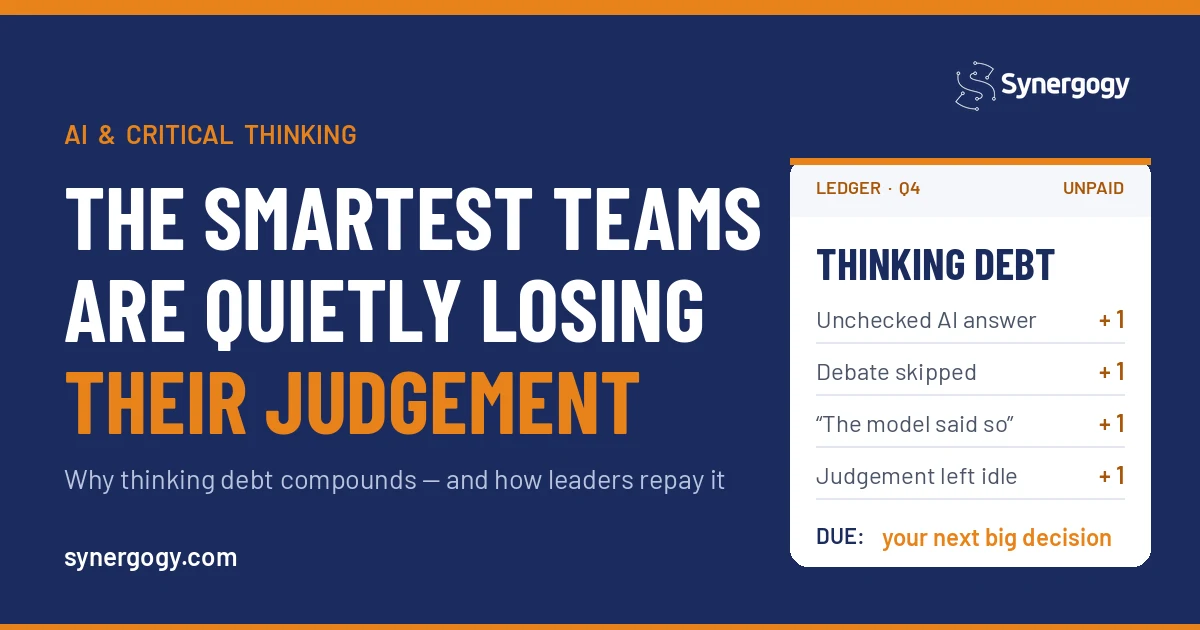
- The unpaid judgement your team skips each time AI answers for them is thinking debt, and it compounds quietly.
- Critical thinking is trainable: six deliberate moves rebuild it without slowing the business down.
AI and critical thinking are moving in opposite directions inside most organisations. The tools draft, summarise and recommend in seconds, yet 66% of people accept AI output without checking its accuracy. The cause has a name: cognitive offloading, the habit of letting a tool think so that you no longer have to. Left alone, that habit hardens into over-reliance on AI, and critical thinking in the workplace erodes at the exact moment leaders need it most. The encouraging part is that the slide is reversible. This article sets out what the research actually shows, names the hidden cost as thinking debt, and explains how to improve critical thinking skills across a leadership team before an unchecked recommendation turns into an expensive decision.
Why AI and critical thinking are pulling apart
The evidence is no longer anecdotal. The KPMG and University of Melbourne global study surveyed more than 48,000 people across 47 countries. It found that 66% rely on AI output without evaluating accuracy, and 56% have made mistakes in their work because of AI. Those two numbers describe the same loop: speed without scrutiny produces errors, and the errors surface downstream, where they cost more.
A second study sharpens the picture. Microsoft Research and Carnegie Mellon University surveyed 319 knowledge workers who use generative AI at least weekly. The pattern was blunt: the more confidence people placed in AI, the less critical thinking they applied to its output. Confidence in their own expertise worked the other way. In other words, the relationship between AI and critical thinking is not fixed. It depends on which confidence a leader feeds.
This matters most in senior roles, because critical thinking for leaders is where unchecked output meets irreversible decisions. A flawed paragraph in a report is an irritant. A flawed assumption in a market-entry recommendation is a write-off.
The root cause: cognitive offloading, and the thinking debt it creates
Cognitive offloading is the delegation of mental work to an external aid. It is ancient and mostly useful; a calendar is cognitive offloading. The difference now is scale. A 2025 study of 666 participants published in Societies found a significant negative correlation between frequent AI tool use and critical thinking ability, with cognitive offloading as the mediating factor. Younger participants showed the highest AI dependence and the lowest critical thinking scores.
Here is a plain way to hold the idea: every time your team accepts an AI answer without testing it, the organisation borrows against its own judgement. Call it thinking debt. Like technical debt, nobody records it, the interest accrues silently, and repayment falls due at the worst possible moment, usually inside a high-stakes decision with a deadline attached. Over-reliance on AI is how the debt builds; a visible method for checking and deciding is how it gets repaid.
Thinking debt also explains why bans fail. Blocking the tools does not restore judgement; it just hides the borrowing. The answer is to keep the speed and reinstate the scrutiny, which is a design problem for critical thinking in the workplace, not a technology problem.
Healthy AI use versus thinking debt: a quick comparison
| Dimension | Healthy AI use | Thinking debt building |
|---|---|---|
| First move | Leader frames the question, then prompts | Tool is opened before the problem is framed |
| Evidence | Output is tested for source, logic and gaps | Fluent output is accepted as finished work |
| Disagreement | AI is used to argue against the draft | AI consensus ends the debate |
| Ownership | A named person owns the final call | “The model suggested it” appears in reviews |
| Skill trend | Judgement is exercised and sharpens | Judgement idles and fades |
If the right-hand column sounds familiar, you are not alone; the KPMG numbers above say most organisations live there. The left-hand column is what deliberate corporate critical thinking training installs.
Six signals that thinking debt is building in your team
You rarely see cognitive offloading directly; you see its symptoms. Watch for these six signals of weakening workplace critical thinking:
- Fluency passes for accuracy. Polished AI drafts sail through review because they read well, not because anyone tested them.
- Meetings get quieter. When the model has “already answered”, people stop arguing. Debate is the first casualty of over-reliance on AI.
- Nobody can explain the recommendation. Ask “why 7% and not 5%?” and the honest answer is “that’s what it produced”.
- Checking feels rude. Questioning an AI-assisted analysis gets read as questioning the colleague who ran it.
- Juniors stop drafting. Developing talent skips the reps that once built judgement, so the pipeline inherits the debt.
- Errors surface downstream. Mistakes appear with clients, auditors or regulators rather than in internal review, the pattern the KPMG data on AI and critical thinking predicts.
Three or more of these signals means cognitive offloading has become culture. That is the moment to intervene deliberately, because critical thinking at work does not recover on its own while the tools keep improving.
How to improve critical thinking skills in an AI-heavy team
Leaders ask how to improve critical thinking skills without slowing delivery. These six moves work because they attach thinking to the workflow your team already runs.
- Think first, then prompt. Require a one-line framing of the problem and a provisional view before anyone opens a tool. Thirty seconds of framing changes what the prompt asks and what the answer is worth.
- Run the same checks on every source. Test AI output and human work identically: where did this come from, does the logic hold, what is missing, does it fit our context? Symmetry removes both blind trust and blind suspicion.
- Make AI the sparring partner, not the author. Ask the tool to attack the draft recommendation, steelman the opposite case, or run a pre-mortem. This converts cognitive offloading into cognitive sparring.
- Triage decisions by stakes and reversibility. Reversible, low-stakes calls can move at machine speed. Irreversible, high-stakes calls get the full treatment. Writing the triage down stops speed from deciding by default.
- Decide what stays human. Agree explicitly which decisions AI may automate, which it may advise on, and which remain human only. Ambiguity here is where over-reliance on AI breeds.
- Practise under pressure, together. Judgement is a team sport. Live simulation with peers, of the kind used in critical thinking workshops for leadership teams, builds the reflex that solo e-learning cannot.
A worked example: the pricing memo
A simplified example, not a client case. A regional director receives an AI-drafted memo recommending a 7% price increase, complete with competitor benchmarks and elasticity estimates. Old habit: skim, approve, forward. New habit: four questions in six minutes. Where do the benchmarks come from? Two of five competitor prices turn out to be eighteen months old. Does the logic hold? The elasticity figure assumes a segment the firm barely serves. What is missing? Churn risk in the two largest accounts never appears. Does it fit? A contract renewal clause caps increases at 4% for a third of revenue. The memo was fluent, fast and wrong, and six minutes of structured scrutiny caught what sign-off would have shipped. That is thinking debt being repaid before interest fell due. Multiply it across every memo a quarter produces, and you can see what workplace critical thinking is actually worth.
Who owns critical thinking in the workplace?
Critical thinking in the workplace fails when it is everyone’s value and no one’s job. Clear ownership is what separates organisations that improve critical thinking skills from those that only talk about it. The split that works:
- The executive team names judgement as a business risk and models the behaviour, asking “what would make this wrong?” in their own meetings. Executive coaching can make that visible at the top.
- CHROs and L&D put the capability on the development agenda alongside leadership development programmes and AI certifications, and measure it before and after, not by attendance.
- Line managers hold the daily norms: humans argue first, then AI joins; every AI-assisted recommendation names its owner.
- Individual leaders keep deliberate practice alive, through formats such as Micro Learning Labs™ or the questioning disciplines taught in coaching skills programmes.
Five common mistakes when fixing AI and critical thinking
Most attempts to rebuild critical thinking at work stumble in one of five predictable ways.
- Banning the tools. Prohibition drives use underground and repays no thinking debt.
- Buying awareness, not behaviour. A webinar about bias changes vocabulary, not decisions. Practice under pressure changes decisions.
- Training individuals, not teams. One sceptical leader in a deferential room loses. Norms beat willpower, which is why cohort-based corporate critical thinking training outperforms solo courses.
- Treating it as an AI literacy problem. Prompt skills and tool knowledge matter, but they sit downstream of judgement. Adaptability and scrutiny are the scarce skills.
- Not measuring anything. If you cannot show judgement improving, the initiative dies at budget time. Baseline it, train, re-test.
A 30-day plan to rebuild critical thinking at work
You do not need a transformation programme to start; you need a month of deliberate reps. Here is a simple sequence any leadership team can run to improve critical thinking skills without new tools or budget:
- Week 1 — baseline. Give the team three short, realistic memos, some human-written and some AI-written, none labelled. Score how many material flaws they catch. This is your measure of AI and critical thinking today, and it is usually humbling.
- Week 2 — install the checks. Agree the four questions every recommendation must answer: source, logic, gaps, fit. Put them in the meeting template, not in a slide deck.
- Week 3 — flip the tool. For one live decision, use AI only to argue against the preferred option. This single habit converts cognitive offloading into sparring and does more to build critical thinking than any lecture.
- Week 4 — re-test and decide. Re-run the memo exercise, compare scores, and decide what becomes permanent: the norms, the triage rules, and who owns them.
Teams that run this cycle discover that strengthening critical thinking in the workplace costs minutes, not days, and that the minutes repay themselves on the first flawed memo they catch.
Build the capability, not just the awareness
Reading about AI and critical thinking changes nobody’s Tuesday. If this describes your leadership team, the fastest route from awareness to behaviour is a live, cohort-based programme. Synergogy’s Critical Thinking for Leaders in the Age of AI runs as two live online sessions for 12–20 leaders, built around realistic cases, a field test on real work and a 30-day reinforcement cycle, with before-and-after judgement scores so the change is measured rather than assumed. It sits within our wider workplace learning portfolio, and you can explore more thinking on the Synergogy Blog.
To scope a cohort for your organisation, write to info@synergogy.com.
One question to carry into your next leadership meeting: when AI gave your team its last confident answer, who in the room was paid to doubt it?
FAQ
Cognitive offloading is the habit of delegating mental work to an external aid, such as an AI tool, a search engine or a calendar. Research published in Societies (2025) links frequent AI-driven offloading to measurably weaker critical thinking, because thinking that is skipped is skill that stops being exercised.
Not automatically. A Microsoft Research and Carnegie Mellon survey of 319 knowledge workers found critical thinking declined when people trusted AI more than their own expertise. Used as a sparring partner rather than an author, AI can sharpen judgement instead of replacing it.
Thinking debt is the judgement an organisation stops exercising each time a team accepts an AI answer unchecked. Like technical debt, it accrues silently and falls due during high-stakes decisions. Repaying it means reinstating structured scrutiny testing sources, logic, gaps and fit — before acting.
Six moves work: frame the problem before prompting; apply the same checks to AI and human work; use AI to argue against drafts; triage decisions by stakes and reversibility; agree what stays human; and practise together in live simulations, with judgement measured before and after.
Over-reliance on AI is accepting machine output as finished work without evaluation. KPMG and the University of Melbourne found 66% of people rely on AI output without checking accuracy, and 56% have made work mistakes because of AI. Visible checking routines are the antidote.
Latest Post
- Automation Bias: Why Smart Leaders Trust AI Too Much
- KPI Maturity Model: Where Does Your Organisation Stand, and How Do You Move Up?
- KPI Dashboard Best Practices: From Data Clutter to Decisions
- KPI vs Metrics: The Difference, With Examples and a Promotion Test
- Leading and Lagging Indicators: Examples, Differences and How to Balance Both