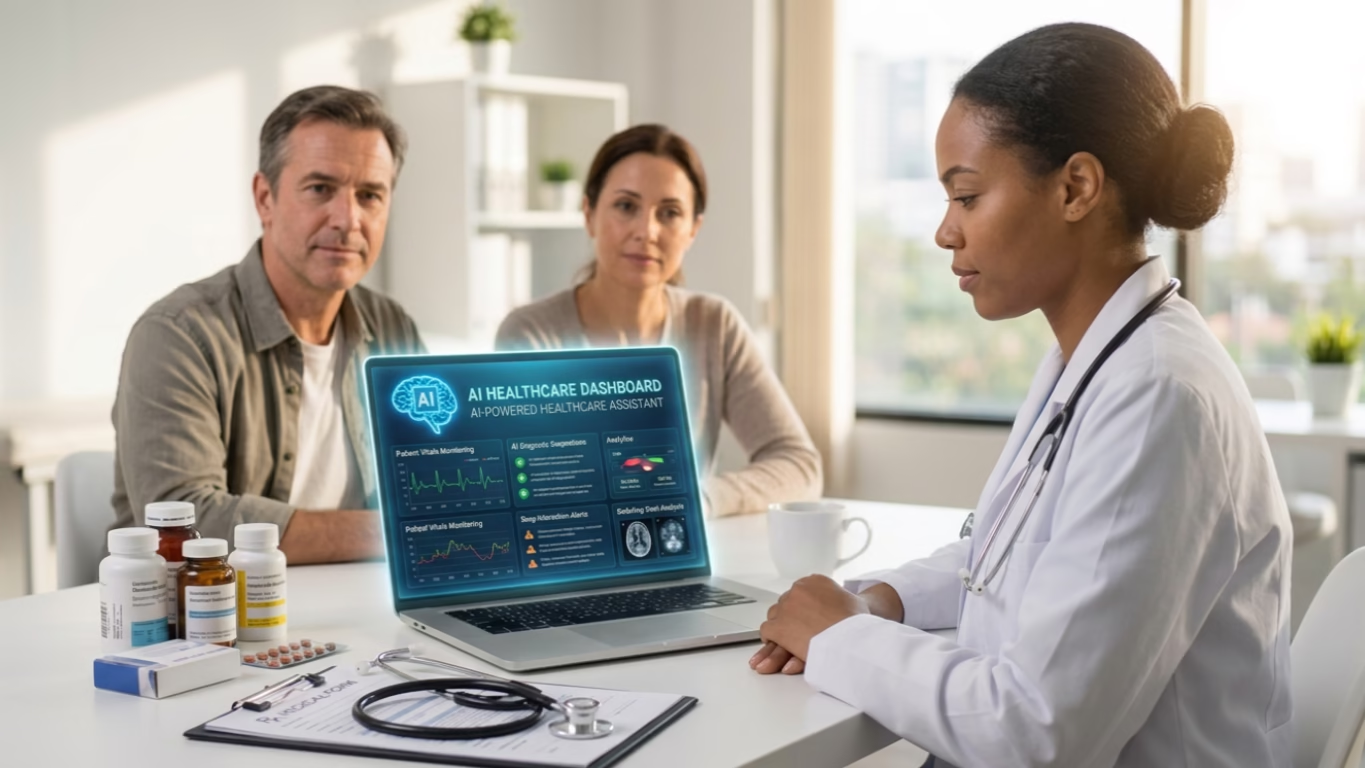
Something remarkable is happening in clinics and hospitals: AI in healthcare now helps read lab results, flag abnormalities on scans, and support diagnostic decisions in seconds. This doesn’t replace clinicians — it makes informed ones more powerful. This guide shows healthcare professionals across India and worldwide how AI for healthcare actually works, from predictive analytics to clinical decision support, why no technical background is required, and how an AI healthcare certification keeps you essential as the field changes. For teams handling patient data under laws like the DPDP Act, using AI responsibly is now central to safe, modern care.
Key Takeaways
- AI in healthcare assists clinicians by analyzing data, reading patterns, and supporting diagnostic decisions without replacing human judgment.
- In 2026, AI helps manage the overwhelming volume of medical data, allowing earlier risk detection and enhancing care efficiency.
- AI supports healthcare through various applications like lab result analysis, predictive analytics, and personalized medicine.
- You don’t need a technical background to utilize AI in healthcare; tools are designed for clinicians to interpret insights easily.
- Obtaining an AI healthcare certification can enhance your skills and keep you relevant as technology evolves in the healthcare field.
What Is AI in Healthcare?
AI in healthcare is the use of artificial intelligence to analyze medical data, support diagnosis and treatment decisions, and improve how care is delivered. Specifically, AI reads patterns in lab results, images, and records, then surfaces insights and predictions — while clinicians interpret those insights, apply judgment, and remain responsible for every decision about a patient.
Why AI in Healthcare Matters in 2026
Medicine has always run on information — symptoms, test results, histories, and evidence. However, the volume of that data now exceeds what any human can process alone.
That’s where AI helps. It reads thousands of data points quickly, flags what deserves attention, and predicts risks earlier. As a result, clinicians catch problems sooner and spend more time on care. Meanwhile, the professionals who understand these tools are exactly who healthcare organizations now need most.
Snippet-ready answer: AI in healthcare matters in 2026 because medical data has outgrown human capacity to process it alone. AI reads results, flags risks, and supports decisions faster — while clinicians stay in control and become more effective.
That’s why structured programs like Synergogy’s AI Specialization track are in rising demand across the healthcare sector.
Where AI Supports Healthcare Every Day
AI shows up across the care journey. Here’s where AI in healthcare delivers the biggest value:
- Lab result analysis — read patterns and flag abnormal values instantly.
- Diagnostic support — highlight findings on scans and images for clinician review.
- Predictive analytics — identify patients at risk before symptoms escalate.
- Personalized medicine — tailor treatment options to individual patient data.
- Medical data analysis — turn scattered records into usable insight.
- Operational efficiency — streamline scheduling, triage, and workflows.
Notice the theme: AI handles the reading and the pattern-spotting, so clinicians focus on judgment, care, and the patient in front of them.
AI Reads. The Clinician Diagnoses.
This is the most important point in the entire discussion, so let’s be precise. AI supports diagnosis — it does not make it.
An algorithm can flag a suspicious shadow on an X-ray or an out-of-range lab value. However, it can’t examine the patient, weigh their history, consider context the data misses, or take responsibility for care. Only a qualified clinician can do that. In fact, health regulators approve these tools as clinical decision *support*, precisely because a human must remain in the loop.
Therefore, responsible AI in healthcare keeps the clinician firmly in control. AI reads, flags, and predicts. The clinician interprets, decides, and advises. Understanding that boundary — and defending it — is exactly what keeps a healthcare professional essential rather than replaceable.
No Technical Background Required
Here’s the reassuring truth. You don’t need to code or be a data scientist to use AI in healthcare, because these tools are built for clinicians and healthcare teams.
In practice, AI works through familiar systems — imaging platforms, record systems, and dashboards. The AI runs in the background; you interpret the insights and apply your clinical knowledge. Everything is framed in clinically relevant terms.
To be clear, only a basic understanding of healthcare is needed, not technical expertise. So if you’re a doctor, nurse, allied health professional, healthcare administrator, or student, this skill set is fully within reach — and your clinical judgment is the foundation it builds on.
🚀 Ready to bring AI into your practice? Build practical, clinically focused skills with Synergogy’s AI certification programs at your own pace.
Patient Safety, Privacy, and Responsible AI
Healthcare involves the most sensitive data there is, and decisions that affect lives. So responsible use and compliance are non-negotiable.
Patient Data and Privacy
First, protect patient data. Healthcare teams must respect India’s DPDP Act, the GDPR for European patients, and CCPA in California. In addition, security standards like ISO 27001 govern how sensitive medical records are stored and shared.
Bias, Validation, and Oversight
Second, insist on safety. Clinical AI must be validated and checked for bias, since a model that works for one population may fail another. Consequently, human oversight and clinical judgment remain essential at every step.
Strong AI governance ties it together — keeping AI fair, transparent, and accountable across the full compliance lifecycle, from data collection and consent through use, storage, and deletion.
Responsible AI in healthcare checklist:
- Keep clinicians in control — humans make every diagnosis and care decision.
- Protect patient data — follow DPDP, GDPR, CCPA, and ISO 27001 standards.
- Validate and check bias — ensure AI works safely across all patient groups.
- Verify AI outputs — treat AI as decision support, confirmed by clinical judgment.
Ultimately, responsible AI in healthcare isn’t a limitation. On the contrary, it’s what keeps patients safe.
Traditional Healthcare vs. AI-Supported Healthcare
| Factor | Traditional Healthcare | AI-Supported Healthcare |
|---|---|---|
| Lab results | Manual review | AI-flagged, faster |
| Risk detection | Spotted late | Predicted earlier |
| Data | Scattered records | Unified, analyzed |
| Treatment | One-size-fits-most | Personalized to the patient |
| Diagnosis | Clinician | Clinician + AI support |
| Coding needed? | No | No |
The takeaway is simple. AI doesn’t replace healthcare professionals — instead, it gives them faster insight and earlier warning, while clinical judgment and responsibility stay firmly human.
Why Get an AI Healthcare Certification
You can pick up bits of this on the job. However, a structured, healthcare-specific certification is faster, deeper, and far more credible to employers.
A strong AI healthcare certification gives you three things. First, structure — diagnostics support, data analysis, predictive analytics, ethics, and compliance taught in the right order. Second, proof — a globally recognized credential, aligned to international standards. Third, confidence — clinically relevant training rather than generic tech theory.
The AI+ Healthcare Fundamentals™ certification, delivered by Synergogy as an Authorized Training Partner of AI CERTs®, is built for exactly this. Designed for healthcare professionals, it requires no technical background and covers AI applications such as predictive analytics, diagnostic algorithms, clinical decision support, medical data analysis, machine learning, NLP, personalized medicine, and ethical and regulatory frameworks. Explore the full range in Synergogy’s AI certification catalog.
🎓 Stay essential. Enroll in the AI+ Healthcare Fundamentals™ certification and lead AI-supported care with confidence.
How to Bring AI Into Your Healthcare Practice in 7 Steps
- Learn the fundamentals.
First, understand what AI can and can’t do in care — explained in clinical terms, no coding.
- Start with data and results.
Next, get comfortable reading AI-flagged lab results and analytics.
- Use diagnostic support.
Then apply AI insights on imaging and findings to inform, not replace, your judgment.
- Explore predictive analytics.
Learn how AI identifies at-risk patients earlier.
- Understand personalized medicine.
After that, see how AI tailors options to individual patient data.
- Practice responsibly.
Meanwhile, keep clinicians in control, protect data, and follow DPDP, GDPR, CCPA, and ISO 27001.
- Get certified.
Finally, earn an AI healthcare certification to prove your skills and stay essential.
FAQ
AI in healthcare is the use of artificial intelligence to analyze medical data, support diagnosis and treatment decisions, and improve care delivery. AI reads patterns in lab results, images, and records, then surfaces insights and predictions, while clinicians interpret them and remain responsible for every decision. It matters because medical data has outgrown what any human can process alone. As a result, AI helps clinicians catch problems earlier and work more effectively, making AI-literate professionals highly valued across the healthcare sector.
No, and this is the crucial point. AI supports diagnosis but does not make it. An algorithm can flag a suspicious finding on a scan or an abnormal lab value, but it can’t examine the patient, weigh their history, or take responsibility for care. Only a qualified clinician can. Health regulators approve these tools as clinical decision support precisely because a human must stay in the loop. AI reads and flags; the clinician interprets, decides, and advises. That human judgment is what keeps care safe.
No. AI healthcare tools are built for clinicians and healthcare teams, not programmers. They work through familiar systems like imaging platforms, record systems, and dashboards, with the AI running in the background. You interpret the insights and apply your clinical knowledge, and everything is framed in clinically relevant terms. The AI+ Healthcare Fundamentals™ certification requires only a basic understanding of healthcare, not technical expertise. Your clinical judgment is the foundation the AI skills build on
Latest Blog
- Workforce Planning Tools and Frameworks: A Practical Guide with Examples
- How to Create a RACI Matrix: 7 Steps, Example and Template
- Hiring Is Broken: The Behavioural Interviewing Questions That Fix It When Every CV Is AI-Polished
- Fractional CHRO Cost in the UAE: The Complete 2026 Pricing Guide
- UAE Emiratisation Compliance Guide 2026–27: Targets, Fines, Nafis and How to Stay Ahead