How to Build Psychological Safety in a Team Where People Are Afraid to Speak Up
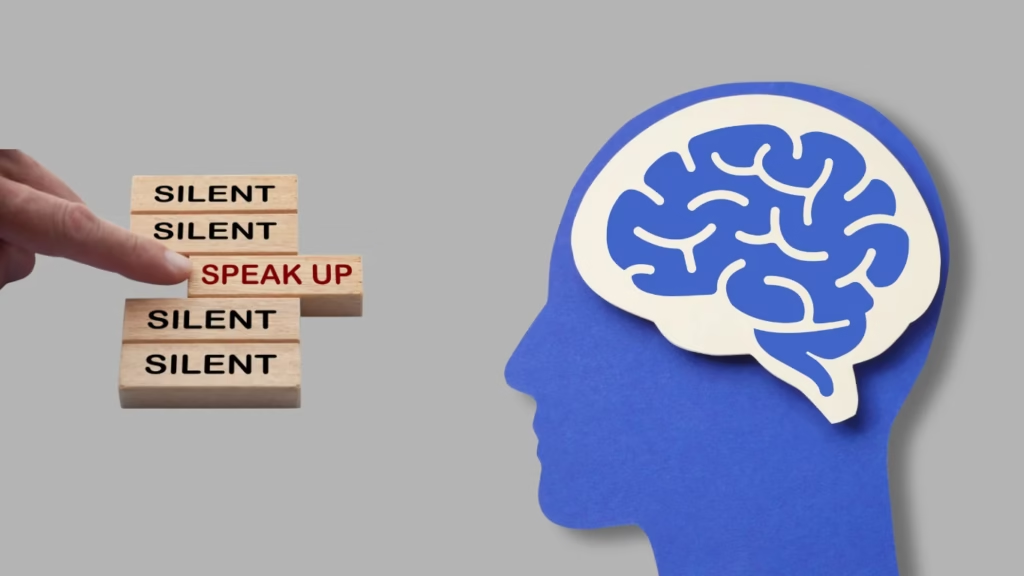
If you want to understand how to build psychological safety in a team, start by looking at your last five meetings and asking one question: who did not speak? The signs your team lacks psychological safety are often hiding in plain sight in the silence after you ask for opinions, in the nodding that replaces honest pushback, and in the ideas that never make it into the room. The connection between psychological safety and team performance is not theoretical — Google’s Project Aristotle identified it as the single most important factor in high-performing teams. Yet most managers do not understand which specific leader behaviours that create psychological safety they need to adopt, or exactly how to encourage speaking up at work in a way that is consistent enough to actually change the team’s culture.
Key Takeaways
- Psychological safety in a team supports open communication and enhances performance, making it crucial for high effectiveness.
- Signs of lacking psychological safety include silence in meetings, hidden mistakes, limited idea contributions, and excessive agreement.
- Leaders can build psychological safety by modeling vulnerability, responding without judgment, and consistently following up on contributions.
- To encourage speaking up, create low-stakes opportunities, explicitly ask for dissent, and visibly recognize contributions.
- Building psychological safety is a continuous practice that strengthens team culture and fosters better performance over time.
Why Psychological Safety Is the Foundation of Every High-Performing Team
Psychological safety is not a soft concept. Harvard Business School professor Amy Edmondson defines it as the shared belief that the team is safe for interpersonal risk-taking. In practice, this means team members feel confident they can speak up, ask questions, admit mistakes, and challenge assumptions without facing ridicule, punishment, or exclusion.
The Performance Case for Psychological Safety
When psychological safety is present, teams innovate faster and escalate problems earlier. They collaborate more effectively and make fewer avoidable errors. Consequently, they recover from setbacks more quickly than teams operating under chronic self-censorship.
In contrast, teams without psychological safety withhold the very information, ideas, and concerns that would most benefit the organisation. People stay silent not because they have nothing to offer but because the perceived cost of speaking up feels higher than the benefit.
What the Research Actually Shows
Google’s Project Aristotle studied 180 teams to identify what made some dramatically more effective than others. The researchers expected the answer to involve talent, structure, or processes. Instead, they found that psychological safety was the single variable that separated the highest performers from the rest.
Furthermore, a 2021 McKinsey study found that organisations with high psychological safety reported significantly higher engagement, lower attrition, and stronger commercial outcomes. The evidence is not ambiguous psychological safety and team performance are directly and measurably linked.
The Signs Your Team Lacks Psychological Safety
Before you can build psychological safety, you need to accurately assess whether it currently exists. The signs your team lacks psychological safety are rarely dramatic. They accumulate gradually and by the time they become obvious, the cultural damage is already significant.
Silence in Meetings
The most visible sign is a pattern of silence. People attend meetings, listen carefully, and leave without contributing a single observation, question, or challenge. When you ask “does anyone have thoughts?” and the room goes quiet, your team is not agreeing with you. That silence signals that speaking up feels too costly.
No One Admits Mistakes
In psychologically unsafe teams, team members hide mistakes for as long as possible. They cover up errors and minimise problems because they fear the response. As a result, small issues compound into large ones because no one felt safe enough to surface them early.
Ideas Only Come From the Same People
When psychological safety is low, the same two or three people contribute the majority of ideas. The rest observe. This is not because they have nothing to offer. Experience has taught them that the team does not consistently welcome their contributions. Therefore, if your team’s creative output comes from a small subset of voices, that pattern is a clear diagnostic signal worth investigating.
Excessive Agreement and No Constructive Challenge
Teams with low psychological safety avoid disagreement. People agree publicly and challenge privately. Decisions get made without genuine debate and false consensus creates the illusion of alignment where none actually exists. This is one of the most dangerous signs your team lacks psychological safety, because you cannot see it coming until something goes wrong.
Leader Behaviours That Create Psychological Safety
Psychological safety is not something you announce it is something you consistently demonstrate. The leader behaviours that create psychological safety are specific, observable, and repeatable. Each one signals to the team that speaking up is safe, valued, and consequential.
Modelling Vulnerability First
The single most powerful thing a leader can do is go first. Admit your own mistakes openly. Ask for help when you need it. Share your uncertainties about a decision before the team feels pressure to validate it. When you demonstrate that vulnerability is acceptable at your level, you give every team member permission to do the same.
Team members watch how you respond to your own imperfection far more closely than they listen to what you say about psychological safety. Therefore, modelling vulnerability is not a nice gesture it is a structural necessity for any leader serious about building a safe team environment.
Responding to Contributions Without Judgment
Every time a team member offers an idea, raises a concern, or asks a question, your response either increases or decreases psychological safety. A dismissive reaction trains the team to stay silent. A genuinely curious response “tell me more about that” trains the team to contribute more.
Responding without judgment does not mean agreeing with everything. It means separating your evaluation of the idea from your regard for the person who offered it. This distinction is one of the most critical leader behaviours that create psychological safety in daily practice.
Following Up on What People Raise
Nothing destroys psychological safety faster than raising a concern and having it disappear. When team members speak up and nothing happens no acknowledgement, no follow-up, no visible action they conclude that speaking up was pointless. Consequently, they stop doing it.
When you follow up consistently even to say “we cannot act on this right now, but here is why” you signal that every contribution was heard, valued, and considered. That consistency builds the trust that psychological safety depends on.
The Psychological Safety Training Micro Learning Lab at Synergogy gives managers a structured, practical framework for developing all of these behaviours with live conversation practice and direct feedback built into every session.
How to Encourage Speaking Up at Work — Practical Strategies That Work
Knowing how to encourage speaking up at work requires you to create structural conditions for contribution not just interpersonal ones. Both matter. Neither works without the other.
Create Regular Low-Stakes Contribution Opportunities
Build low-stakes contribution into your team’s weekly rhythm. Use short check-in rounds at the start of meetings. Run brief retrospectives after significant events. Ask one question that every person in the room answers before the group moves on. These structures set contribution as the default expectation and they surface the voices currently staying silent.
Ask for Dissent Explicitly
Most managers ask “does everyone agree?” which is an invitation for silence. Reframe the question instead. “What are we missing here?” “What is the strongest case against this decision?” “Who sees this differently?” These questions make dissent the expected response rather than the exceptional one. As a result, team members feel invited to challenge rather than pressured to conform.
Respond Visibly When People Speak Up
When someone takes the risk of raising a difficult point, your visible response determines whether that behaviour gets repeated by them and by everyone else watching. Thank them for raising it. Engage with the substance. If the concern turns out to be unfounded, explain why clearly and without condescension.
The quality of your response to the first few brave contributions sets the cultural expectation for every contribution that follows. The Psychological Safety Training Micro Learning Lab at Synergogy equips managers across Dubai, Abu Dhabi, and the UAE with the specific skills and leadership behaviours needed to build genuinely psychologically safe teams.ule.
How to Build Psychological Safety in a Team in 5 Steps
- Step 1 — Assess your team’s current level of psychological safety
Before making any changes, gather honest data on where your team currently stands. Observe who speaks in meetings and who stays silent. Notice whether mistakes get raised early or hidden until they become crises. Ask yourself whether your team’s public agreement matches the private conversations you have with individuals. This diagnostic step gives you a clear starting point and prevents you from solving the wrong problem.
- Step 2 — Model vulnerability and imperfection openly
Start every psychological safety initiative with yourself. Admit a recent mistake in a team setting. Ask for input on a decision you are uncertain about. Say “I do not know — what do you all think?” in a meeting where you would previously have provided the answer. These acts of deliberate vulnerability give your team explicit permission to do the same. No cultural change programme accelerates this shift faster than a leader who goes first.
- Step 3 — Change how you respond to contributions
Audit your responses to team member contributions over the next two weeks. For every idea, question, or concern that is raised, ask yourself: did my response make this person more or less likely to contribute again? Replace evaluative first responses with curious ones. “Tell me more about that” and “what is driving that concern?” are more powerful cultural signals than any policy or initiative you can introduce.
- Step 4 — Create regular structured opportunities for contribution
Build low-stakes contribution into your team’s weekly rhythm. Use short check-in rounds at the start of meetings. Ask one question that every person in the room answers before the group moves on. Run brief retrospectives after significant events. These structures make contribution the default expectation rather than the exception — and they surface the voices that are currently staying silent.
- Step 5 — Follow up on every concern that is raised
Track every concern, idea, or challenge that team members raise with you. Follow up on each one — even if the outcome is that you cannot act on it right now. The follow-up demonstrates that speaking up had a consequence, which is the strongest possible reinforcement that doing so was worth the risk. Teams where contributions disappear without acknowledgement learn quickly that silence is the safer choice.
Conclusion — Psychological Safety Is Built One Conversation at a Time
Learning how to build psychological safety in a team is not a one-time initiative. It is a sustained leadership practice built through hundreds of small, consistent moments where you choose curiosity over judgment, follow-up over forgetting, and contribution over compliance.
The Compounding Return on Psychological Safety
The connection between psychological safety and team performance is cumulative. Each time a team member speaks up and receives a positive response, their willingness to contribute again increases. Each time a concern is raised and followed up, trust deepens.
Over months and years, these moments compound into a team culture where people bring their best thinking to work because they know it will be heard, considered, and valued. Eliminating the signs your team lacks psychological safety, adopting the leader behaviours that create psychological safety consistently, and knowing how to encourage speaking up at work are not separate projects. They are interconnected practices that reinforce each other and together produce the kind of team environment where exceptional performance becomes expected.
Your Next Step Towards a Psychologically Safe Team
The Psychological Safety Training Micro Learning Lab at Synergogy gives you the structured, evidence-based toolkit to make this shift with confidence. Explore the programme today or reach out directly at info@synergogy.com to discuss how psychological safety training fits your team’s current needs and development goals.
Explore our Offerings
Latest Post
- AI+ Nurse Practitioner™ AI at the Bedside in 2026: The Certification That Puts Nurses Ahead of the Technology Curve
- AI Just Entered Drug Discovery in 2026 — The Pharma Certification That Puts You on the Frontier
- Chief AI Officer Is the Hottest Title of 2026: Here’s How to Earn It
- AI in HR 2026: From CV Screening to Workforce Strategy With a Single Certification
- How to Use AI for Research and Data Analysis (No Coding Needed)