How to Build a Performance Management Process That Actually Improves Employee Output
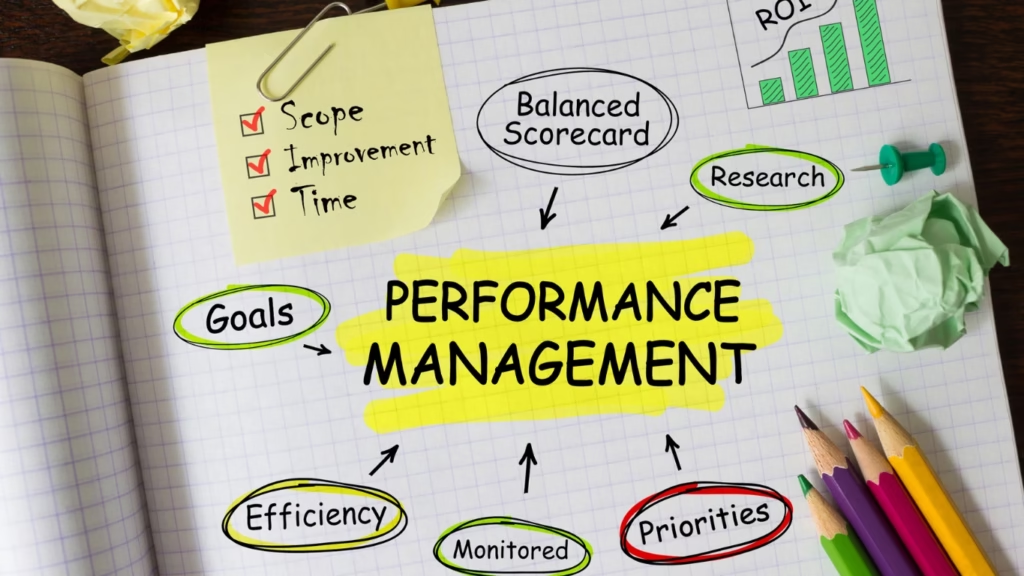
A well-designed performance management process is one of the most powerful levers a business has for sustained growth — yet most organisations get it wrong. They build systems that measure the past instead of shaping the future, generate paperwork instead of conversations, and produce compliance instead of commitment. The result is a process that exhausts everyone and changes nothing. Genuinely improving employee output requires a fundamentally different approach — one built around clear employee performance goals, regular performance feedback for employees that is specific and actionable, and a shift to continuous performance management that replaces the annual review with an always-on culture of performance. This article gives you the framework to build that system from the ground up.
Key Takeaways
- Most performance management processes fail due to outdated annual reviews that hinder development and timely feedback.
- Shifting to a continuous performance management process captures timely feedback and fosters supportive, ongoing conversations.
- Effective employee performance goals should be specific, co-created, and regularly reviewed to drive genuine output.
- Managers need training to deliver impactful performance feedback, ensuring it is specific, timely, balanced, and developmental.
- Integrating performance management with capability development helps improve employee output by fostering a growth-oriented culture.
Why Most Performance Management Processes Fail
Before redesigning your approach, it helps to understand where traditional systems break down.
The annual performance review is the most common failure point. Conducted once a year, it asks managers to recall twelve months of behaviour from memory, compress it into a rating, and deliver it in a single conversation that the employee has no opportunity to prepare for. Unsurprisingly, research consistently shows that most employees find annual reviews demotivating — and most managers dread giving them.
There are three deeper structural problems behind this. First, the feedback arrives too late to change anything. By the time a manager flags an issue in December, the team member has repeated the same behaviour for eleven months. Second, the process focuses on evaluation rather than development. It tells people what they did wrong without giving them the tools or support to do better. Third, goals set in January are rarely revisited — even when priorities change dramatically, which they always do.
Therefore, any performance management process that relies entirely on annual cycles is structurally designed to underperform.
The Shift That Changes Everything: Continuous Performance Management
The most effective organisations have made a decisive shift from annual performance reviews to continuous performance management — a model where performance conversations, goal check-ins, and feedback exchanges happen throughout the year rather than once at the end of it.
This shift matters for two reasons. First, it makes feedback timely. When a manager addresses a performance gap within days rather than months, the employee can actually act on it. Second, it makes the process feel less like judgement and more like support. Regular, low-stakes check-ins reduce the anxiety that annual reviews generate — and increase the likelihood that employees will engage honestly with the process.
Continuous performance management does not require more time overall. It simply redistributes it — replacing one high-stakes annual conversation with a series of shorter, more frequent ones that are less stressful for everyone and dramatically more useful.
Building a Performance Management Process That Actually Works
The following framework gives managers and HR leaders a practical structure for designing a performance management process oriented entirely around improving employee output — not just measuring it.
Set Employee Performance Goals That Drive the Right Behaviour
The foundation of any effective performance management process is goal-setting. However, not all goals are created equal. Employee performance goals that drive genuine output share three characteristics: they are specific enough to guide daily decisions, ambitious enough to stretch capability, and connected clearly to broader team or organisational priorities.
The OKR framework — Objectives and Key Results — is one of the most effective tools for achieving this. It separates aspirational direction (the Objective) from measurable outcomes (the Key Results), ensuring that goals are both motivating and trackable. Crucially, OKRs are reviewed and updated quarterly rather than annually, which keeps them relevant even as business conditions evolve.
Co-Create Goals With Your Team — Not For Them
Whatever goal framework you use, the principle is the same: employee performance goals should be co-created between manager and employee, not handed down from above. When people have agency over their goals, their ownership of outcomes increases dramatically.
Make Performance Feedback for Employees Specific and Frequent
Goals without feedback are intentions without direction. Performance feedback for employees is the mechanism that connects current behaviour to desired outcomes — and it is where most managers struggle most.
Effective performance feedback has four qualities. First, it must be specific not you need to communicate better but in yesterday’s client meeting. I noticed you interrupted twice before they finished speaking. Second, timeliness matters: deliver feedback as close to the observed behaviour as possible, not weeks later. Third, good feedback is balanced acknowledging what is working alongside what needs to change. Finally, the most impactful feedback is developmental: focused on growth, not judgement.
Furthermore, feedback should flow in both directions. The most high-performing teams create cultures where employees regularly share upward feedback with their managers — not just the other way around. This two-way exchange signals genuine respect for performance at every level of the organisation.
How To: Build a Performance Management Process in Five Steps
- Step 1 — Audit Your Current Process Honestly
Before building anything new, assess what you currently have. Ask three questions: Do employees find the current process useful? Do managers feel equipped to have meaningful performance conversations? Does the process lead to measurable improvement in employee output? If the answer to any of these is no, you have a clear starting point for redesign.
- Step 2 — Set Quarterly Employee Performance Goals
Replace annual goal-setting with a quarterly cycle. At the start of each quarter, managers and employees co-create three to five specific, outcome-focused goals aligned to team priorities. Review progress at the midpoint. Adjust as needed. This cadence keeps goals live and relevant — and keeps the conversation going throughout the year.
- Step 3 — Introduce Fortnightly One-to-One Check-Ins
The engine of continuous performance management is the fortnightly one-to-one. These structured 30-minute conversations should cover three things: progress against current goals, any blockers or support needed, and one specific piece of performance feedback from the manager. Consistency matters more than length — a reliable fortnightly rhythm builds trust faster than irregular longer sessions.
- Step 4 — Build Manager Capability for Performance Feedback
The most common reason performance management processes fail is under-skilled managers. Giving specific, constructive performance feedback for employees is a learned skill — not an innate one. Therefore, invest in equipping your managers with the language, frameworks, and practice they need to hold effective performance conversations confidently.
- Step 5 — Review, Recognise, and Recalibrate
At the end of each quarter, hold a structured performance review conversation that celebrates progress, identifies development needs, and sets the goals for the next cycle. Annual reviews should become summaries of four quarters of ongoing dialogue — not surprise evaluations. Additionally, embed recognition into the process: when employees see that good performance is noticed and acknowledged, their motivation to sustain it increases significantly.
The Link Between Performance Management and Team Capability
Improving employee output through process design alone only goes so far. The organisations that see the most sustained performance improvement combine a strong performance management process with deliberate capability development — ensuring employees have the skills they need to achieve the goals being set for them.
This is where continuous performance management becomes a learning system rather than just a measurement system. When managers use regular one-to-ones to identify skill gaps, they can connect employees to relevant learning immediately. This turns performance management and capability development into one integrated flow — not two separate HR initiatives.
Furthermore, when employees understand that the performance process exists to help them grow — not just to evaluate and rate them — their engagement with it increases dramatically. That shift in perception, more than any process redesign, is what determines whether your performance management system actually delivers.
Build the Skills That Make Performance Management Work
If you want to equip your managers with the capability to lead effective performance conversations, explore Synergogy’s Performance Management Training — a focused Micro Learning Lab™ designed to build practical performance management skills fast.
For managers also developing their influencing and feedback capabilities, our Influencing Skills Training and Problem Solving Training complement performance management development directly. Browse the full Micro Learning Labs™ library for the complete range of programmes.
Final Thought
A performance management process that actually works is not the most complex system you can build — it is the most consistent one. When managers set meaningful employee performance goals, deliver honest and timely performance feedback for employees, and commit to continuous performance management through regular check-ins and quarterly reviews, the compound effect on improving employee output is remarkable.
Performance does not improve because you measured it. It improves because someone cared enough to coach it and built a system that made that coaching happen reliably, week after week, quarter after quarter.
Frequently Asked Questions
A performance management process is a structured system through which organisations set goals, monitor progress, deliver feedback, and develop employees to improve their performance over time. Effective processes are continuous rather than annual, and focused on development rather than evaluation alone.
Improving employee output requires three things working together: clear, co-created performance goals; regular, specific feedback that connects current behaviour to desired outcomes; and manager capability to hold developmental performance conversations. Process design supports all three — but manager skill is the critical variable.
The most effective employee performance goals are specific, outcome-focused, co-created between manager and employee, and reviewed quarterly rather than annually. OKRs Objectives and Key Results — are widely regarded as one of the most effective frameworks for setting and tracking performance goals at team and individual level.
Performance feedback for employees is most effective when it is timely — delivered as close to the observed behaviour as possible. Fortnightly one-to-one check-ins provide a reliable cadence for ongoing feedback, supplemented by in-the-moment feedback whenever a significant behaviour occurs. Annual feedback cycles alone are consistently shown to be ineffective.
Continuous performance management is an approach that replaces annual reviews with year-round performance conversations, regular goal check-ins, and ongoing feedback exchanges. It distributes performance dialogue across the year rather than concentrating it into a single high-stakes event making feedback more timely, more actionable, and less stressful for both managers and employees.