How to Use DISC Profiles to Improve Team Communication and Reduce Interpersonal Friction
Understanding how to use DISC profiles to improve team communication is one of the most practical investments any manager or HR professional can make — because most interpersonal friction at work is not caused by bad intentions but by style differences that nobody has ever been taught to recognise. Reducing interpersonal friction at work starts with helping people understand why others communicate, decide, and respond to pressure so differently from themselves. DISC behavioural styles in teams provide the shared language that makes these differences visible — and therefore manageable — rather than mysterious and frustrating. Building self-awareness with DISC assessment is the first step in a process that transforms how individuals relate to colleagues, give feedback, and navigate disagreement. Finally, DISC for managers and leadership development gives leaders the behavioural intelligence to adapt their style, motivate diverse teams, and build the kind of psychological safety where every person can perform at their best.
Key Takeaways
- Understanding how to use DISC profiles to improve team communication reduces interpersonal friction at work by recognizing behavioral style differences.
- DISC measures four styles: Dominance, Influence, Steadiness, and Conscientiousness, helping individuals understand their own and others’ communication styles.
- Self-awareness starts with an individual DISC assessment, which is essential for effective team communication and reducing conflicts.
- Using DISC, teams can decode existing friction, adapt communication styles, and improve meetings for better decision-making.
- Building a DISC-informed team culture reinforces understanding and respect for differences, creating a psychologically safe environment.
Why Interpersonal Friction Costs More Than Most Organisations Realise
Interpersonal friction is one of the most pervasive and least-measured performance drains in organisational life. Unlike a missed deadline or a failed project, friction leaves no clean trace in the data. It shows up instead as slowed decisions, avoided conversations, duplicated effort, and the quiet erosion of trust that precedes attrition.
Research from CCP Global consistently shows that employees spend an average of 2.8 hours per week dealing with conflict — a figure that scales dramatically in teams where style differences are unacknowledged and unmanaged. The financial cost across an organisation of any size is substantial. Yet most of this friction is preventable — not by eliminating difference, but by giving people the awareness and language to work across it productively.
What DISC Actually Measures — and What It Does Not
The Four Behavioural Styles Explained
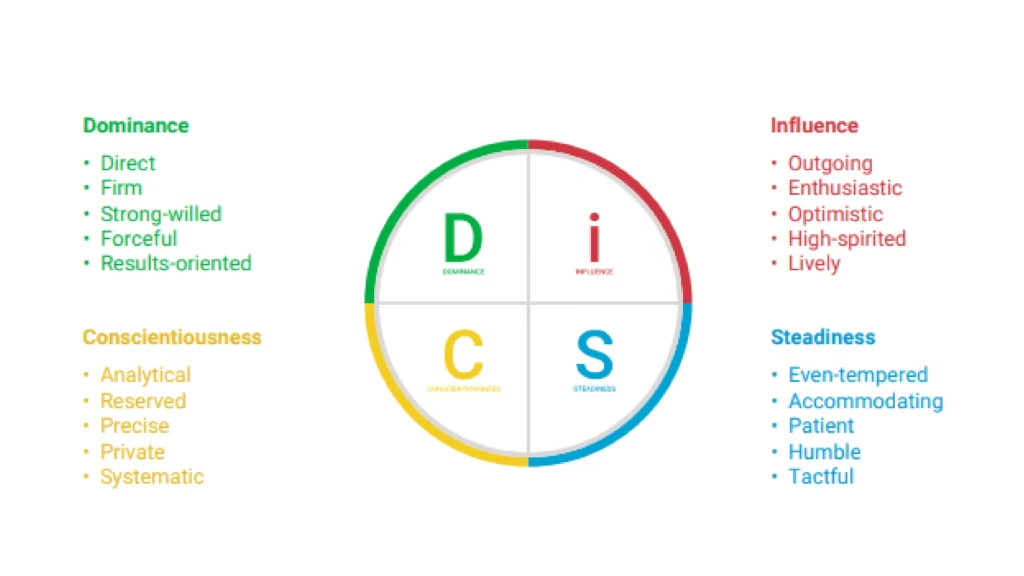
DISC is a behavioural assessment framework that measures four primary style dimensions: Dominance, Influence, Steadiness, and Conscientiousness. Each dimension describes a pattern of behaviour in work settings — how a person approaches problems, influences others, responds to pace and change, and engages with rules and quality.
D — Dominance: Direct, decisive, results-driven. Moves fast, takes charge, values efficiency. Frustrated by indecision and lengthy process. I — Influence: Enthusiastic, collaborative, people-oriented. Values connection, recognition, and creative energy. Disengages when communication is purely transactional. S — Steadiness: Patient, loyal, consistent. Values harmony, predictability, and genuine relationship. Feels pressured by abrupt change and aggressive urgency. C — Conscientiousness: Analytical, precise, quality-focused. Values accuracy, logic, and thorough process. Resists decisions made without sufficient evidence.
What DISC Does Not Measure
DISC measures behavioural style — not intelligence, values, potential, or emotional health. It describes how people prefer to operate, not how capable they are. This distinction matters because DISC profiles are tools for awareness and communication — not instruments for judgement, selection, or ranking. Every style has genuine strengths and genuine blind spots. No style is superior. This framing is essential for creating the psychological safety that allows DISC insights to be used productively rather than defensively.
How to Use DISC Profiles to Improve Team Communication — Six Practical Applications
1. Start With Individual Self-Awareness
Before DISC can improve team communication, each team member needs to understand their own profile clearly — including both their strengths and their blind spots. Building self-awareness with DISC assessment begins with guided individual debrief: understanding not just which style is dominant, but how that style shows up under pressure, how it is likely to be perceived by others, and which situations bring out the best and the most challenging aspects of that person’s natural approach.
This individual awareness is the foundation. Without it, DISC becomes a labelling exercise rather than a development tool. Synergogy’s DISC Assessment provides the validated profiling and facilitated debrief that turns data into genuine self-understanding — the starting point for every meaningful application that follows.
2. Map Your Team’s Collective Style Profile
Once individual profiles are clear, map the team’s collective DISC composition. This team map reveals the style balance — and imbalance — that shapes how the group communicates, makes decisions, and handles conflict by default.
A team heavy in D and I styles moves fast, decides quickly, and generates energy — but may underinvest in quality checking, risk analysis, and structured follow-through. A team heavy in S and C styles is thorough, careful, and harmonious — but may struggle with urgency, creative risk-taking, and direct confrontation of underperformance. Understanding DISC behavioural styles in teams at this collective level helps managers design better meetings, assign work more intentionally, and anticipate where friction is most likely to emerge before it surfaces as conflict.
3. Use DISC to Decode the Source of Existing Friction
Most interpersonal friction in teams has a style-difference explanation that neither party has ever considered. The D-style manager who sends a two-line email and expects immediate action is not being rude — they are communicating in their natural style. The C-style team member who feels disrespected by that email is not being oversensitive — they are experiencing a genuine style clash that feels like dismissal.
When teams learn to decode friction through a DISC lens, interpersonal conflicts lose much of their emotional charge. “They are deliberately difficult” becomes “they process information differently and need a different kind of communication.” This reframe is the single most powerful contribution DISC makes to reducing interpersonal friction at work — and it is available the moment team members have profile awareness and a shared language to apply it.
4. Adapt Communication Style Deliberately
Knowing your own DISC profile and your colleague’s profile creates an immediate, practical opportunity: you can adapt how you communicate to increase the likelihood that your message lands as intended. This is the applied skill at the heart of how to use DISC profiles to improve team communication.
For a D-style colleague: lead with the bottom line, be direct, and respect their time. For an I-style colleague: open with connection before content, acknowledge their contribution, and invite their enthusiasm. For an S-style colleague: give advance notice, allow processing time, and frame change with reassurance. For a C-style colleague: bring data, structure your argument logically, and give them time to evaluate before expecting commitment. These adjustments take seconds and prevent the hours of re-explanation, re-work, and relationship repair that style-blind communication consistently creates. Synergogy’s Emotional Intelligence Using DISC program builds this adaptive communication skill across entire teams.
5. Apply DISC to Team Meetings and Decision-Making
Team meetings are where DISC style differences generate the most visible friction — and where deliberate DISC application delivers the fastest, most measurable improvement. D-styles dominate discussion. I-styles generate ideas faster than they can be evaluated. S-styles hold back until explicitly invited. C-styles need processing time that the pace of the room rarely allows.
A DISC-informed meeting design addresses all four needs simultaneously. Circulate the agenda in advance — for C and S styles. Open with brief connection — for I styles. Establish a clear decision outcome — for D styles. Use structured round-robin input before open discussion — so S and C voices are heard before D and I styles set the direction. These simple structural adjustments dramatically improve both the quality of decisions and the inclusion experience of every team member.
6. Use DISC for Manager Development and Leadership Effectiveness
DISC for managers and leadership development goes beyond team communication into the manager’s own style awareness and its impact on everyone they lead. A high-D manager unintentionally creates a high-pressure, low-safety environment for S and C-style team members. A high-I manager builds warmth and energy but may frustrate C-style professionals who need structure and evidence. Every manager’s natural style has both gifts and costs — and DISC makes both visible.
When managers understand their own profile, they can deliberately flex toward the styles their team members need — rather than consistently rewarding those who are most like themselves and inadvertently marginalising those who are not. This is the leadership equity insight that makes DISC one of the highest-leverage tools in any manager’s development programme. Synergogy’s DISC Personality Training equips managers with the complete DISC application toolkit — from self-awareness to team communication to leadership effectiveness.
Building a DISC-Informed Team Culture Over Time
Individual DISC awareness creates immediate value. Team-level DISC culture creates compounding value — because when a shared language becomes embedded in how a team talks about communication and conflict, the benefits accumulate with every interaction.
Build the following into your team’s ongoing rhythm. Reference DISC in one-to-ones when discussing how a team member prefers to receive feedback or be recognised. Use DISC language in project briefings when assigning work that plays to different style strengths. Return to the team map when new members join — updating the collective profile and facilitating a team conversation about what this means for how the group works together.
Synergogy’s Communication Skills Training reinforces DISC application in the specific communication contexts — feedback, meetings, difficult conversations, and written communication — where style differences most frequently create friction. Together with Psychological Safety Training, DISC creates the foundation for a team where differences are understood, respected, and used as a source of strength rather than a source of friction.
Explore Synergogy’s full Micro Learning Labs™ catalogue to build connected DISC, communication, and leadership capability across your entire organisation — in focused sessions that deliver immediate, real-world application from day one.
How to Use DISC Profiles to Improve Team Communication
A 5-step process managers and teams can apply immediately.
- Complete individual DISC assessments with facilitated debrief.
Every team member understands their own style — strengths, blind spots, and pressure responses.
- Map the team’s collective DISC profile.
Identify style balance, likely friction points, and collective decision-making tendencies.
- Decode existing friction through a DISC lens.
Replace “they are difficult” with “we have a style difference” — and address it practically.
- Adapt your communication style to each team member’s profile.
Lead with their needs — pace, detail, connection, or directness not your own preference
- Embed DISC language into meetings, feedback, and one-to-ones.
When DISC becomes a shared team language, its value compounds with every interaction.
Explore our Offerings
Latest Post
- How to Communicate Effectively Across Cultures in a Diverse Multinational Workplace
- How to Use DISC Profiles to Improve Team Communication and Reduce Interpersonal Friction
- How to Develop Emotional Intelligence as a Leader When Stress and Pressure Make You Reactive
- How to Build a Genuinely Inclusive Workplace That Goes Beyond Policies and Tick-Box Training
- How to Build a Customer Service Culture That Turns Complaints Into Long-Term Loyalty