Adapting communication style using DISC is one of the most immediately practical skills any professional can develop. Most communication breakdowns at work do not stem from bad intentions — they stem from style mismatches. DISC personality types at work describe four distinct behavioural profiles: Dominance, Influence, Steadiness, and Compliance. Each profile communicates, decides, and processes information differently. DISC communication skills for managers equip leaders to recognise these differences and adapt their approach accordingly — rather than expecting everyone to meet them on their own terms. Adapting to different personality styles is not a compromise of authenticity. It is the hallmark of genuine communication intelligence. In this article, we explore five practical ways to use DISC behavioural styles in the workplace to communicate more effectively with every person on your team, in every interaction that matters.
Key Takeaways
- Adapting communication style using DISC helps professionals navigate style mismatches and improve workplace interactions.
- DISC identifies four personality types: Dominance, Influence, Steadiness, and Compliance, each with unique communication preferences.
- Tailoring communication approaches to each DISC type boosts team performance, reduces friction, and fosters better relationships.
- High-D professionals prefer brevity; High-I professionals seek connection; High-S professionals value care; High-C professionals need evidence.
- Developing self-awareness of your own DISC style is crucial for effective communication with others.
Why Adapting Communication Style Using DISC Changes Everything
Most communication problems at work share a common root. Two people interact. Both have good intentions. Neither adjusts their natural style to meet the other. The result is friction, misunderstanding, and frustration — not because either party failed, but because neither recognised that they were speaking a different behavioural language.
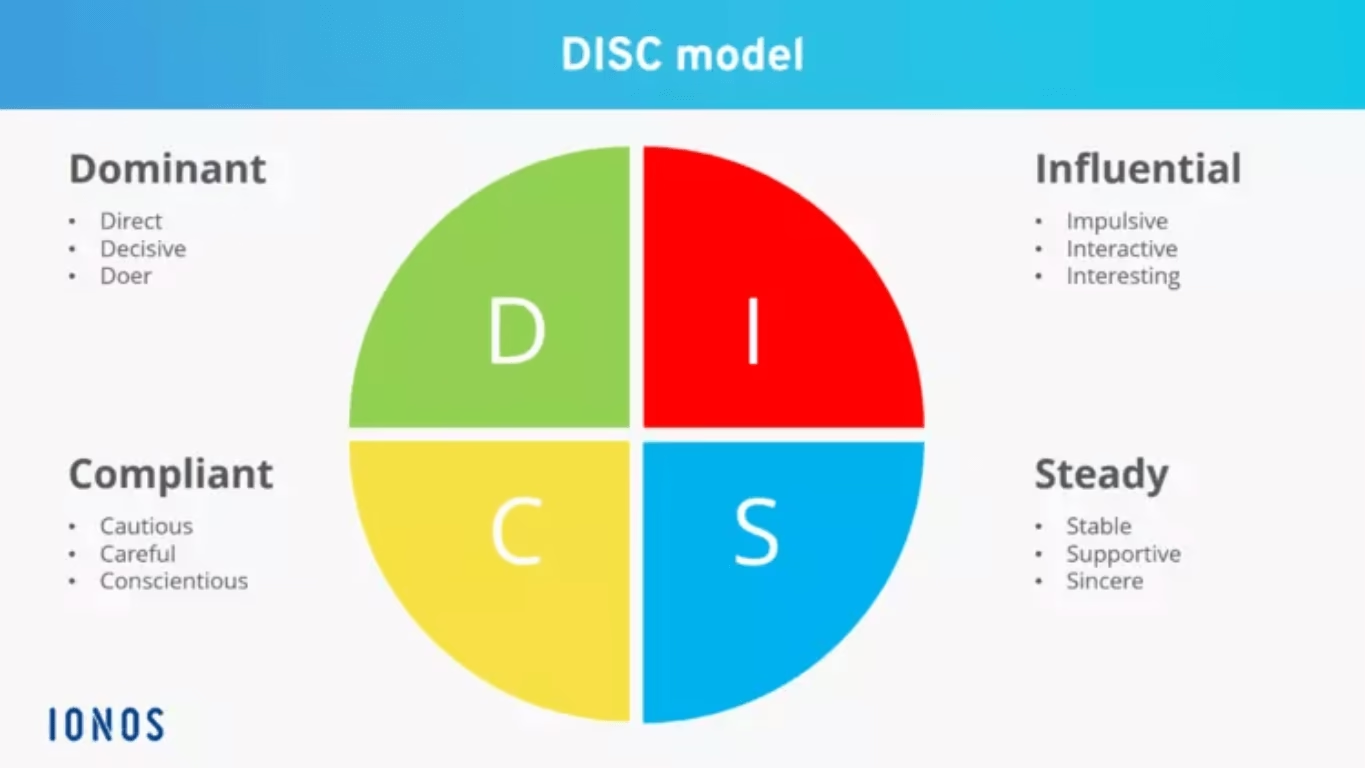
DISC behavioural styles in the workplace make those differences visible. The framework identifies four primary behavioural dimensions. Dominance describes professionals who are direct, decisive, and results-focused. Influence describes those who are expressive, enthusiastic, and relationship-oriented. Steadiness describes those who are patient, reliable, and team-focused. Compliance describes those who are analytical, precise, and quality-driven.
Each DISC personality type at work has distinct communication preferences. High-D professionals want brevity and outcomes. High-I professionals want energy and connection. High-S professionals want consistency and genuine care. High-C professionals want accuracy and evidence. When you communicate in a style that does not match these preferences, even your most important messages fail to land — not because of what you said, but because of how you said it.
Furthermore, the ability to flex your style when communicating with different DISC personality types at work is a learnable skill. It does not require you to abandon your natural style. It requires you to extend your range — to develop the behavioural flexibility that makes you genuinely effective with every person on your team, not just those who naturally match your own profile.
Visit Synergogy to explore how the Micro Learning Labs™ DISC Communication Skills programme develops this flexibility systematically — giving your professionals and managers the tools to communicate more effectively across every DISC behavioural style in the workplace.
The Four DISC Personality Types at Work — A Quick Reference
Before exploring the five strategies, a clear reference for each DISC style is essential. Understanding the core communication preferences of each profile is the foundation of adapting communication style using DISC in practice.
D — Dominance: Direct, decisive, competitive, and results-driven. High-D professionals value speed, efficiency, and control. They dislike small talk, over-explanation, and indecision.
I — Influence: Enthusiastic, optimistic, collaborative, and expressive. High-I professionals value recognition, relationship, and excitement. They dislike excessive detail, rigidity, and isolation.
S — Steadiness: Patient, loyal, supportive, and consistent. High-S professionals value harmony, stability, and genuine care. They dislike sudden change, conflict, and impersonal interactions.
C — Compliance: Analytical, precise, quality-focused, and systematic. High-C professionals value accuracy, standards, and evidence. They dislike vagueness, emotional pressure, and shortcuts.
These four DISC behavioural styles in the workplace are not fixed personality labels. They describe behavioural preferences — tendencies that shift with context and under pressure. Most professionals show a blend of styles, with one or two dominant patterns. Recognising those patterns — in yourself and in others — is the first step in adapting to different personality styles effectively.
5 Ways to Adapt Your Communication Style to Every Personality Type Using DISC
1. Match Your Pace and Directness to the D Style
Adapting communication style using DISC with High-D professionals requires one primary adjustment: get to the point faster. High-D personalities value time above almost everything else.
Therefore, when communicating with a High-D colleague, manager, or stakeholder, lead with the recommendation — not the background. State your position in one sentence. Then offer to provide supporting detail if needed. Avoid long preambles, excessive caveats, and conversational openers that delay the substance. High-D communicators read this as a lack of confidence or preparation.
Furthermore, High-D professionals respond best to challenge when it comes with an alternative solution attached. Do not simply raise a problem — bring a proposal. Do not simply disagree — bring a counter-recommendation. This approach signals competence and respects their decision-making style simultaneously.
DISC communication skills for managers who lead High-D team members include one additional critical tool: giving them ownership. High-D professionals disengage when they feel over-directed. Assign outcomes — not prescriptive processes. Give them the result you need and let them determine how to reach it. This is one of the most immediately effective applications of adapting to different personality styles in management practice.
Synergogy’s Communication Skills Using DISC programme builds these style-specific communication adjustments as practical habits — through real-world scenarios that reflect the exact DISC personality types at work your professionals encounter every day.
2. Build Energy and Recognition Into Your Communication With the I Style
High-I professionals are energised by enthusiasm, recognition, and genuine human connection. Adapting communication style using DISC with this profile means bringing energy to your interactions — matching their expressiveness rather than dampening it with excessive formality or detail.
Begin interactions with connection before content. Ask about their experience, their ideas, or their perspective before moving to the task. Acknowledge their contributions visibly and specifically. High-I professionals genuinely need to feel valued — not as a preference but as a psychological requirement for sustained engagement and trust.
When communicating complex or detailed information to a High-I professional, deliver the headline first. Then invite them into a collaborative exploration of the detail rather than presenting it as a sequential report. They engage better with information when they feel like a participant rather than a recipient. Use stories and examples to anchor abstract concepts — High-I professionals remember narratives far more effectively than data tables.
Moreover, adapting to different personality styles with High-I team members includes managing the detail-to-relationship balance carefully. High-I professionals can lose focus when buried in data. Keep communications concise, energetic, and clearly connected to outcomes they care about — people, impact, and recognition. DISC behavioural styles in the workplace confirm this pattern consistently across industries and geographies.
3. Slow Down and Demonstrate Genuine Care With the S Style
High-S professionals are the most loyal, patient, and supportive communicators in any team. They also tend to be the least likely to speak up when something is wrong. Adapting communication style using DISC with High-S team members therefore requires a deliberate investment in safety and sincerity.
Slow your communication pace. Allow pauses. Ask how they are — and actually wait for the answer. High-S professionals read rushed interactions as signals that their perspective is not important. This erodes trust quietly and cumulatively. Taking 30 additional seconds to acknowledge a High-S team member’s experience builds more loyalty than an hour of motivational communication with any other style.
When introducing change to a High-S professional, always explain the reasons before the implications. Sudden announcements without context are deeply unsettling for this profile. Give them time to process. Check in after the initial conversation. Provide consistent reassurance without being condescending. Their hesitation is not resistance — it is a request for more information and more time.
DISC communication skills for managers who lead High-S team members also include learning to ask explicit, open questions about concerns. High-S professionals rarely volunteer disagreement. They need to be invited into honest dialogue through questions that signal genuine interest — not just procedural check-ins. Adapting to different personality styles with this profile is ultimately an investment in consistent, patient attention.
4. Provide Evidence and Structure When Communicating With the C Style
High-C professionals — the Compliance style in DISC behavioural styles in the workplace — bring analytical rigour, quality focus, and systematic thinking to every interaction.
Adapting communication style using DISC with High-C professionals means arriving prepared with data, evidence, and well-structured reasoning. Present your logic clearly before your conclusion. Anticipate the questions they will ask and address them proactively. Acknowledge the limitations of your proposal as well as its strengths — High-C professionals respect intellectual honesty far more than confident oversimplification.
Furthermore, High-C professionals need processing time. Do not expect immediate decisions in a meeting. Send relevant information in advance. Allow them to review, analyse, and formulate questions before the conversation. Rushing a High-C professional into a decision typically produces either a poor decision or a delayed one — because their standard for decision-making involves thorough evaluation, not fast instinct.
When delivering feedback to High-C team members, be specific and evidence-based. Avoid emotional framing or vague impressions. “The report contained three calculation errors on page four” lands far more effectively than “I felt the quality wasn’t quite right.” DISC personality types at work respond to feedback most constructively when it matches their own standard for precision and evidence.
Synergogy’s Communication Skills Using DISC training develops these style-specific communication adjustments across all four DISC profiles — equipping your professionals to flex their approach with precision and confidence in every interaction.
5. Develop Your Own Style Awareness Before Adapting to Others
The final and most foundational strategy for adapting communication style using DISC is developing accurate awareness of your own natural profile. Without this self-knowledge, style adaptation is guesswork. With it, the entire framework becomes practical, targeted, and immediately useful.
Your natural DISC style creates predictable communication strengths — and equally predictable blind spots. High-D communicators are efficient but can appear dismissive. High-I communicators are engaging but can appear unfocused. High-S communicators are warm but can appear indecisive. High-C communicators are thorough but can appear cold or over-critical. Each style has specific situations where its defaults work brilliantly — and specific situations where they create friction.
Developing DISC communication skills for managers therefore begins with a structured DISC assessment that maps your own behavioural profile accurately. This gives you a clear baseline: where your natural style serves you, where it creates unintended impact, and specifically which adjustments will most improve your communication effectiveness with each of the other DISC personality types at work.
Furthermore, self-awareness accelerates the development of adapting to different personality styles because it makes the adjustment deliberate rather than reactive. When you know your natural default, you can recognise the moment you need to flex — and choose a more effective approach before the conversation goes wrong rather than after.
Visit Synergogy to explore how the Micro Learning Labs™ DISC programme combines individual style assessment with practical communication skill-building — creating both the self-awareness and the application skills that make adapting communication style using DISC a genuine and sustainable daily practice.
The Business Case for DISC Communication Skills in Organisations
The commercial impact of developing DISC communication skills for managers and professionals is both immediate and measurable. Research from TTI Success Insights — whose validated DISC tool Synergogy uses exclusively — demonstrates that teams with trained DISC awareness report significantly fewer interpersonal conflicts, faster decision-making, and higher overall communication effectiveness scores within three months of completing their DISC development programme.
Furthermore, adapting to different personality styles reduces the communication friction that consumes disproportionate management time in most organisations. Misunderstandings, avoidance, and interpersonal tension all decrease when team members have a shared language for behavioural differences. The result is a measurable improvement in team cohesion, collaboration quality, and speed of execution — without adding a single structural process to the organisation’s existing rhythm.
For organisations operating across India, the UAE, ASEAN, and globally, DISC behavioural styles in the workplace carry additional significance. In multicultural environments where communication norms vary significantly by culture and context, DISC provides a universal framework for understanding behavioural differences that transcends cultural variables. It gives diverse teams a shared vocabulary that makes style differences discussable — and therefore manageable — without requiring cultural expertise.
Synergogy delivers Communication Skills Using DISC through the Micro Learning Labs™ format — focused 2–3 hour sessions that combine individual DISC profile awareness with immediate practical application. Every participant leaves with a personalised understanding of their own DISC style and specific, immediately applicable strategies for adapting communication style using DISC across all four DISC personality types at work.
FAQ
The four DISC personality types at work are Dominance (D), Influence (I), Steadiness (S), and Compliance (C). Each describes a distinct pattern of behavioural preferences in workplace settings. High-D professionals are direct and results-focused. High-I professionals are expressive and relationship-oriented. High-S professionals are patient and team-focused. High-C professionals are analytical and quality-driven. Most professionals show a blend of styles, with one or two dominant patterns shaping their communication preferences most strongly.
Adapting communication style using DISC reduces the interpersonal friction that arises from style mismatches — which account for the majority of communication breakdowns in professional teams. When managers and team members learn to recognise DISC behavioural styles in the workplace and adjust their approach accordingly, conversations become more effective, decisions happen faster, and relationships become stronger. The result is measurably higher team performance, lower conflict frequency, and greater engagement across every DISC profile.
DISC communication skills for managers go beyond general principles by providing a specific, validated behavioural framework for understanding why different people communicate differently — and exactly how to adapt your approach for each profile. Rather than offering universal techniques, DISC gives managers a personalised map of their own style and a practical toolkit for adapting to different personality styles in every team interaction, feedback conversation, and stakeholder engagement they navigate.
Synergogy’s Communication Skills Using DISC programme delivers individual DISC profile awareness combined with practical, immediately applicable communication skill-building in a focused 2–3 hour Micro Learning Labs™ session. Participants receive their personal DISC profile, explore their natural communication style strengths and blind spots, and practise specific adjustments for each of the four DISC personality types at work. Synergogy delivers the programme virtually or face-to-face across the UAE, India, ASEAN, and globally — using the TTI Success Insights validated DISC tool exclusively.
Communicate With Every Personality Type — Starting Now
Adapting communication style using DISC is not a theoretical aspiration. It is a practical, immediately applicable skill that transforms how every professional relates to colleagues, direct reports, and stakeholders across every interaction. Understanding DISC personality types at work gives you the framework. Practising DISC communication skills for managers gives you the capability. And consistently adapting to different personality styles gives you the results — stronger relationships, faster decisions, and fewer communication breakdowns across every DISC behavioural style in the workplace.
Synergogy’s Communication Skills Using DISC programme equips your professionals and managers with both dimensions — the individual self-awareness of their own DISC profile and the practical communication flexibility to adapt their approach for every personality type they encounter at work.
Whether you want to develop one manager’s communication effectiveness or embed DISC awareness across an entire leadership population, Synergogy has the expertise, validated tools, and global delivery capability to make it happen — at scale, in context, and with immediately measurable impact.
Ready to help your teams communicate brilliantly with every personality type?
📩 Contact our team today to discuss your DISC communication skills training requirements: info@synergogy.com
Latest Blogs
- Workforce Planning Tools and Frameworks: A Practical Guide with Examples
- How to Create a RACI Matrix: 7 Steps, Example and Template
- Hiring Is Broken: The Behavioural Interviewing Questions That Fix It When Every CV Is AI-Polished
- Fractional CHRO Cost in the UAE: The Complete 2026 Pricing Guide
- UAE Emiratisation Compliance Guide 2026–27: Targets, Fines, Nafis and How to Stay Ahead