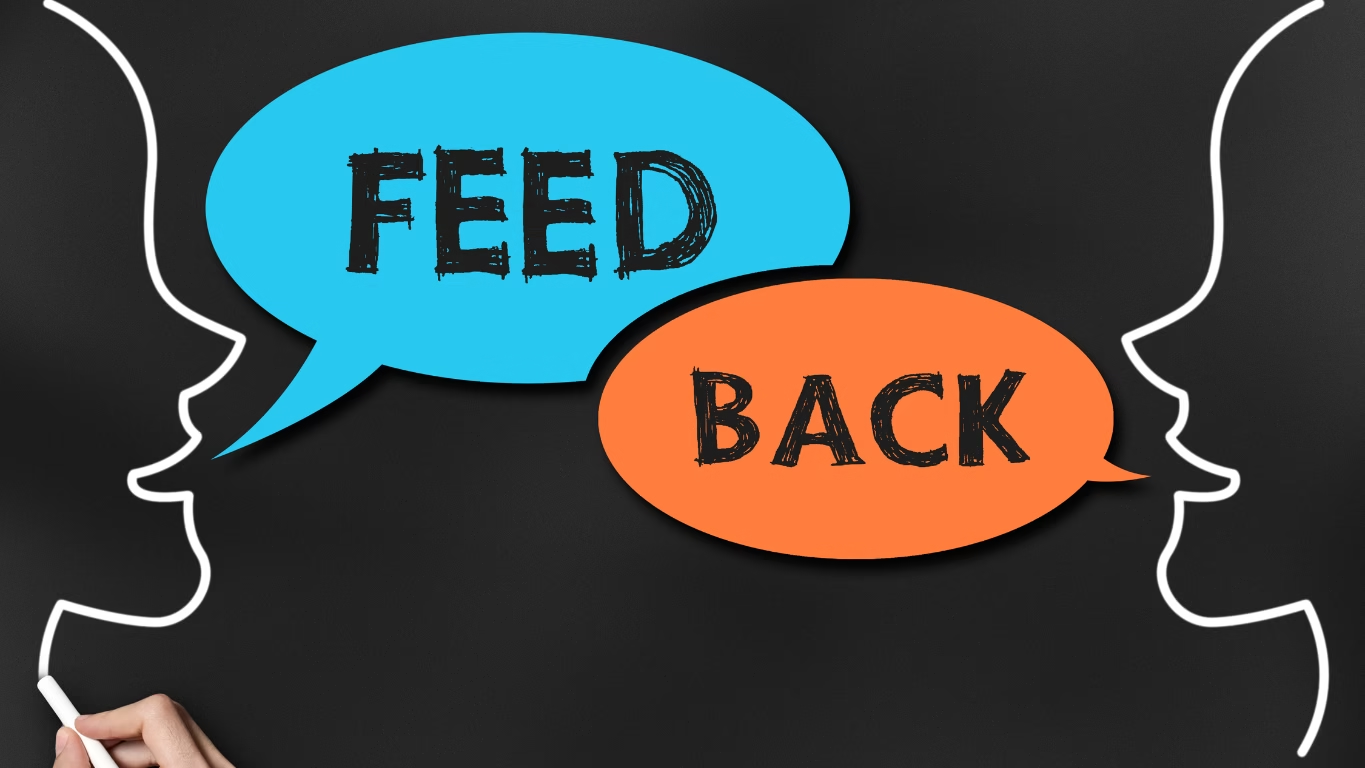
Giving real-time feedback at work is the single most powerful development tool any manager possesses — and the one most consistently deferred to the annual appraisal cycle. By the time the review arrives, the moment has passed. The behaviour has either hardened into a habit or the opportunity for growth has been entirely missed. Continuous feedback for managers is not just a performance management preference — it is a fundamental shift in how development actually happens. Replacing annual appraisals with regular feedback produces faster improvement, stronger relationships, and higher engagement at every level. Real-time performance feedback skills are learnable. And a genuine feedback culture in organisations starts with one manager deciding to stop waiting and start talking. In this article, we explore ten practical steps to make giving real-time feedback a daily discipline — not an annual event.
Key Takeaways
- Giving real-time feedback at work boosts employee engagement and performance compared to annual appraisals.
- Managers must commit to timely feedback within 48 hours to maintain its relevance and effectiveness.
- Using the SBI framework helps structure feedback, making it specific and actionable.
- Building a feedback culture involves making feedback a regular practice, emphasizing both positive and developmental conversations.
- Investing in real-time performance feedback skills leads to lower turnover and better business outcomes.
Why Annual Appraisals Alone Are No Longer Enough
The annual appraisal was designed for a slower-moving world. In that world, performance cycles were predictable. Projects ran for months. Roles were stable. The annual review made sense as the primary feedback moment because the pace of work allowed for it.
That world no longer exists. Projects close in weeks. Priorities shift monthly. Skills become obsolete faster than annual review cycles can address. In this context, replacing annual appraisals with regular feedback is not a management trend — it is a structural necessity. Feedback that arrives twelve months after the behaviour it addresses does not develop people. It surprises them.
Furthermore, research from Gallup found that employees who receive regular, meaningful feedback are nearly four times more likely to be engaged than those who receive feedback only at annual reviews. Separately, Adobe reported that after replacing annual appraisals with regular feedback conversations, voluntary turnover dropped by 30% — and performance-related terminations fell by 50%. The evidence is compelling. Giving real-time feedback at work is not just better for development. It is significantly better for business outcomes.
The barrier is rarely willingness — it is capability. Most managers want to give more frequent feedback. However, they lack the real-time performance feedback skills to do it well.
Visit Synergogy to explore how the Micro Learning Labs™ feedback skills training programme equips your managers with the specific confidence, frameworks, and daily habits needed to make continuous feedback for managers a consistent and effective practice.
10 Steps to Give Real-Time Feedback Without Waiting for the Annual Appraisal
Step 1 — Commit to the 48-Hour Rule
The most important rule in giving real-time feedback at work is simple. Never let more than 48 hours pass between the observed behaviour and the feedback conversation. After 48 hours, memory fades on both sides. Emotional charge dissipates. The connection between the behaviour and its impact becomes harder to articulate and harder to receive constructively.
The 48-hour rule creates a natural accountability structure. It prevents feedback from accumulating into a once-a-year data dump that overwhelms rather than develops. It keeps conversations grounded in specific, recent, observable events rather than vague impressions formed over months. And it makes replacing annual appraisals with regular feedback feel manageable — because each conversation is small, focused, and directly connected to something both parties remember clearly.
Commit to this rule as a non-negotiable. When you observe a behaviour that merits feedback — positive or developmental — schedule the conversation within 48 hours. Not eventually. Not at the next one-to-one. Within 48 hours.
Step 2 — Separate Feedback From Performance Management
Many managers conflate feedback with formal performance management. This conflation makes giving real-time feedback at work feel higher-stakes than it needs to be. Feedback is not a disciplinary process. It is a development conversation. Keeping this distinction clear — in your own mind and in how you frame conversations with your team — makes continuous feedback for managers significantly less anxiety-inducing for both parties.
Developmental feedback is a normal, expected part of every professional relationship. It does not require a formal setting, a documented process, or a HR sign-off. It requires a private space, a specific observation, and a forward-looking question. When managers treat feedback as a natural part of their daily leadership practice — rather than as a formal event with consequences — the feedback culture in organisations shifts from apprehensive to genuinely developmental.
Step 3 — Use the SBI Framework for Every Feedback Conversation
Real-time performance feedback skills begin with a reliable structure. The SBI framework — Situation, Behaviour, Impact — provides exactly that. It gives managers a three-part formula that keeps feedback specific, behavioural, and non-personal in every conversation.
Situation: Describe the specific context. “In this morning’s client presentation…” Behaviour: Describe the specific, observable behaviour — not an interpretation or a character judgement. “You interrupted the client twice before they finished their question…” Impact: Describe the specific consequence. “This made the client appear frustrated and may have undermined our credibility.”
The SBI framework removes the vagueness and subjectivity that make feedback difficult to receive and impossible to act on. It also builds real-time performance feedback skills into a repeatable habit — because the same structure works for positive feedback, developmental feedback, and every conversation in between.
Synergogy’s feedback skills training builds the SBI framework and multiple supporting feedback structures into the Micro Learning Labs™ curriculum — giving managers the tools to deliver every feedback conversation with confidence and precision.
Step 4 — Give Positive Feedback as Frequently as Developmental Feedback
A common mistake in giving real-time feedback at work is treating it primarily as a corrective tool. Continuous feedback for managers should include at least as much positive feedback as developmental feedback — because positive feedback serves a different and equally critical function. It reinforces the behaviours you want to see more of. It builds confidence. And it signals that your attention is not only activated by problems.
Furthermore, positive feedback must be specific to be effective. “Great job” does not develop anyone. “The way you handled that difficult stakeholder question — staying calm, asking for clarification before responding — was exactly the approach we need more of in those situations” builds genuine professional confidence and gives the team member a clear understanding of what excellence looks like.
Make it a habit to deliver at least one piece of specific positive feedback every week to every direct report. This rhythm normalises feedback as a natural part of your leadership relationship — and makes the developmental conversations significantly easier to receive, because they occur in a context of consistent recognition.
Step 5 — Ask Before You Tell
One of the most effective real-time performance feedback skills is also the most counterintuitive. Before offering your observation, ask the team member for theirs. “How do you think that went?” “What would you do differently?” “What did you notice about your own approach?” These questions frequently surface the team member’s own awareness — which, when present, makes the feedback conversation dramatically shorter and more impactful.
When team members already know what they need to improve, telling them yourself adds little developmental value. However, inviting them to articulate it themselves builds the self-reflection muscle that makes ongoing improvement self-sustaining. This ask-first approach is central to building a feedback culture in organisations — because it positions feedback as a collaborative exploration rather than a top-down correction.
Step 6 — Make Feedback a Two-Way Practice
Giving real-time feedback at work is most effective when it flows in both directions. Managers who actively invite feedback on their own leadership — and respond to it genuinely — model the vulnerability that makes feedback culture safe for everyone. Continuously asking your team “What could I do more of, less of, or differently?” signals that feedback is a shared professional practice — not something that flows only downward from authority.
Furthermore, receiving feedback well is itself a real-time performance feedback skill. When a team member offers an observation about your leadership, receive it with curiosity rather than defensiveness. Ask clarifying questions. Thank them specifically. And — most importantly — act on it visibly. When team members see that their feedback changes something in your behaviour, their confidence in the entire feedback culture in organisations increases substantially.
Explore how Synergogy builds reciprocal feedback practices into the Micro Learning Labs™ programme — developing both the giving and receiving dimensions of feedback skills as equally important capabilities.
Step 7 — Address Small Issues Before They Become Large Ones
One of the strongest arguments for replacing annual appraisals with regular feedback is what happens when small performance issues are not addressed in real time. They grow. Unaddressed, a minor quality issue becomes a pattern. A pattern becomes an expectation. An expectation becomes a formal performance concern requiring HR involvement.
Giving real-time feedback at work — even on small issues — prevents this escalation. A brief, specific, private conversation within 48 hours of observing a minor concern is infinitely less stressful for both manager and team member than a formal performance review six months later. Furthermore, it demonstrates genuine care for the team member’s development — because it signals that you noticed, you cared enough to say something, and you believed they could improve.
Step 8 — Choose the Right Setting for Every Conversation
Real-time performance feedback skills include the ability to select the right environment for every feedback conversation. Positive feedback can — and often should — be given publicly.
Developmental feedback, by contrast, must always be given privately. Public correction damages psychological safety, erodes trust, and creates the very fear of feedback that undermines feedback culture in organisations. Private conversations allow the team member to receive feedback without defensiveness — because there is no audience, no status threat, and no performance to protect.
This setting rule is simple. Praise publicly. Develop privately. Applied consistently, it creates a feedback environment where recognition is visible and growth conversations feel safe — the precise conditions that make continuous feedback for managers sustainable over time.
Step 9 — Follow Up on Every Developmental Feedback Conversation
Giving real-time feedback at work is only half of the developmental equation. The other half is following up. After every developmental feedback conversation, check in within two weeks. Ask how the team member is finding the adjustment. Acknowledge any progress you have observed. Offer additional support if needed. And close the loop explicitly when the improvement has been achieved.
This follow-up discipline serves two purposes. First, it demonstrates that your feedback was genuine — that you cared enough about the team member’s development to track it actively. Second, it reinforces the new behaviour at the critical window when it is most likely to solidify into a habit. Continuous feedback for managers is therefore not just about the initial conversation — it is about the development arc those conversations collectively produce.
Step 10 — Build Feedback Into Your Regular Team Rhythm
The final step in replacing annual appraisals with regular feedback is making feedback structural — not just occasional. Build brief feedback moments into your existing management rhythm. End every one-to-one with a mutual feedback exchange. Open every project debrief with a structured reflection on what went well and what to improve. Create a simple signal system — a thumbs up after a presentation, a quick message after a difficult conversation — that normalises micro-feedback as part of daily professional life.
When giving real-time feedback at work becomes structural, it stops depending on the manager’s initiative in any given moment. It becomes an expectation — a feature of the team’s operating rhythm that every team member can rely on and plan around. This is what building a genuine feedback culture in organisations actually looks like. Not a policy. Not a programme. A consistent daily practice that embeds feedback into the fabric of how the team works together.
Synergogy supports organisations in building this feedback rhythm into their management culture at scale — through the Micro Learning Labs™ feedback skills training programme that equips every manager with the skills, confidence, and daily habits to make continuous feedback their professional standard.
The Business Case for Continuous Feedback for Managers
The commercial evidence for investing in real-time performance feedback skills is robust. Deloitte’s research found that companies with continuous feedback practices achieve 14.9% lower turnover than those relying on annual appraisals. Furthermore, McKinsey identifies regular feedback as one of the three highest-impact practices for accelerating individual and team performance — alongside clear goal-setting and purposeful recognition.
These outcomes translate directly into competitive advantage. Organisations with strong feedback culture in organisations attract and retain higher-performing professionals. Their teams develop faster. Their managers become more effective. And their ability to identify and address performance gaps before they become structural problems gives them a measurable resilience advantage over competitors who still rely primarily on annual reviews.
For organisations operating across India, the UAE, ASEAN, and globally, replacing annual appraisals with regular feedback also addresses specific cultural dynamics. In relationship-oriented professional cultures, direct feedback can feel uncomfortable without the right framework and context. Building real-time performance feedback skills that are both honest and relationally sensitive requires structured development — which is precisely what Synergogy’s feedback skills training delivers.
Visit Synergogy to explore the full Micro Learning Labs™ feedback skills training programme and discover how giving real-time feedback at work connects to a broader leadership development journey in coaching skills, performance management, and psychological safety.
FAQ
Giving real-time feedback at work is more effective because it addresses behaviour while memory, context, and emotional relevance are still fresh. Annual appraisals rely on both manager and team member accurately recalling and accurately weighting months of performance — which research consistently shows neither party does well. Continuous feedback for managers produces faster improvement, higher engagement, and stronger professional relationships than feedback that arrives twelve months after the behaviour it addresses.
Managers develop real-time performance feedback skills through structured frameworks, deliberate practice, and specific feedback on their own delivery. The SBI (Situation, Behaviour, Impact) framework provides a reliable structure that keeps feedback specific and behavioural. The 48-hour rule creates the habit of timeliness. And the discipline of asking before telling builds the developmental quality that separates growth conversations from corrective directives. Synergogy’s feedback skills training develops all of these skills in a focused 2–3 hour Micro Learning Labs™ session.
Building a feedback culture in organisations requires action at both individual and structural levels. At the individual level, every manager must develop real-time performance feedback skills and commit to regular, specific, two-way feedback conversations. At the structural level, organisations must embed feedback into team rhythms, reward managers who develop their people through feedback, and replace or supplement annual appraisals with regular performance conversations. Culture follows behaviour — and feedback culture emerges when continuous feedback for managers becomes the consistent organisational norm.
Synergogy’s feedback skills training equips managers with the specific frameworks, language, and daily habits they need to make giving real-time feedback at work a natural and consistent practice. The Micro Learning Labs™ format delivers practical tools — including the SBI framework, positive feedback structures, ask-first questioning techniques, and follow-up disciplines — in a focused 2–3 hour session. Participants leave with immediately applicable skills and the confidence to use them from their very next feedback opportunity.
Stop Waiting for the Annual Appraisal — Start Giving Feedback Now
Giving real-time feedback at work does not require a system overhaul or a policy change. It requires ten habits — each small, each immediately applicable, and each significantly more powerful than the annual appraisal conversation they progressively replace. The ten steps in this article provide everything a manager needs to make continuous feedback for managers a daily professional standard rather than an annual event.
Synergogy’s feedback skills training gives your managers the specific real-time performance feedback skills to deliver every feedback conversation with clarity, confidence, and genuine developmental impact — regardless of the size of the team, the complexity of the performance challenge, or the cultural context in which they operate.
Whether you are building a feedback culture in organisations from the ground up or deepening the feedback capability of an experienced management team, Synergogy has the expertise, methodology, and global delivery capability to make it happen at scale and with lasting impact.
Ready to replace annual feedback delays with real-time development conversations?
📩 Contact our team today to discuss your feedback skills training requirements: info@synergogy.com
Latest Blogs
- AI Just Entered Drug Discovery in 2026 — The Pharma Certification That Puts You on the Frontier
- Chief AI Officer Is the Hottest Title of 2026: Here’s How to Earn It
- AI in HR 2026: From CV Screening to Workforce Strategy With a Single Certification
- How to Use AI for Research and Data Analysis (No Coding Needed)
- How to Write Weeks of Content in a Single Afternoon with AI