Leadership & Organisation Development
The Trust Mirror™: A Two-Way Trust Matrix for Mutual Trust in the Workplace
Mutual trust in the workplace remains the single most under-measured driver of execution, yet most leaders assess it with the wrong instrument. Traditional models treat trust as a one-way judgement, while real relationships run on reciprocal trust that flows in both directions. The Trust Mirror™ is a two-way trust matrix that maps "I trust you" against "you trust me", giving leaders a precise diagnostic for leadership trust at the level where it actually lives: the dyad. Because building trust in teams begins with seeing where trust is asymmetric, this trust matrix names four distinct relationship states and prescribes a movement playbook for each. In this article, we unpack the quadrants, the behavioural markers, and the Catalytic Questioning prompts that turn mutual trust in the workplace from a vague aspiration into a coachable practice.

Why One-Way Models of Leadership Trust Fail
Most leadership trust tools ask a single question: how much do others trust you? Useful, certainly, yet dangerously incomplete. Research published in the Journal of Management by Korsgaard, Brower and Lester (2015) demonstrated that dyadic trust is frequently asymmetric — one party often extends far more trust than the other returns. Earlier, Lewicki, McAllister and Bies (1998) showed that trust and distrust can coexist within the same relationship, which explains why "do they trust me?" surveys consistently miss the friction leaders feel daily.
Consequently, reciprocal trust — not one-way confidence — predicts whether delegation sticks, whether feedback lands, and whether teams move at speed. When leadership trust flows one way only, organisations pay for it in second-guessing, duplicated checking, and stalled decisions. The Trust Mirror™ addresses this gap directly. Rather than averaging trust into a single score, this trust matrix separates the two directions so leaders can finally see which way their trust deficit runs. Moreover, because building trust in teams is relational rather than reputational, the remedy differs depending on which axis is broken.
The Trust Mirror™: A Trust Matrix With Two Honest Axes
The Trust Mirror™ plots two questions that every working relationship silently negotiates. The horizontal axis asks: to what degree do I trust you? The vertical axis asks: to what degree do you trust me? Crossing them produces four quadrants, each with three naming layers — a primary name for coaching, a metaphoric name for keynotes, and a corporate name for boardrooms.
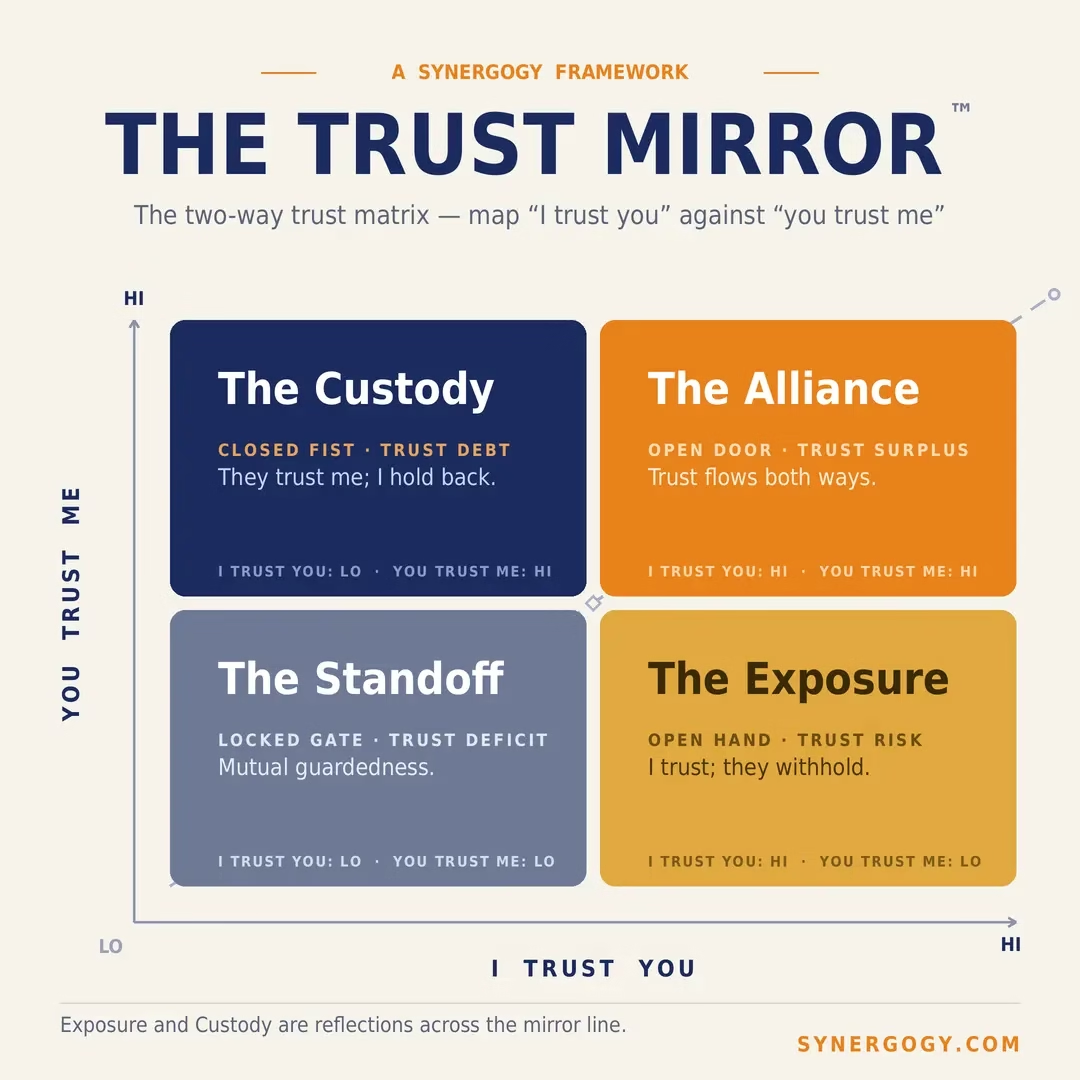
| Quadrant | Primary | Metaphoric | Corporate |
|---|---|---|---|
| Hi / Hi | The Alliance | Open Door | Trust Surplus |
| I trust Hi / They trust Lo | The Exposure | Open Hand | Trust Risk |
| They trust Hi / I trust Lo | The Custody | Closed Fist | Trust Debt |
| Lo / Lo | The Standoff | Locked Gate | Trust Deficit |
Unlike older quadrant tools that label people (allies, adversaries), the Trust Mirror™ labels relationship states. This distinction matters enormously for mutual trust in the workplace: states can be moved; labels tend to stick. Therefore, leaders working with our executive coaching practice plot each key relationship on the trust matrix and revisit the map quarterly, because reciprocal trust shifts with context, pressure, and behaviour.
The Alliance: Where Mutual Trust Compounds
The Alliance is the quadrant where mutual trust in the workplace pays compound interest. Trust flows both ways, so transaction costs collapse. Behavioural markers include:
- Unguarded candour. Both parties disagree openly without rehearsing or softening excessively, a hallmark of genuine team trust.
- Clean delegation. Work is handed over without shadow-tracking; leadership trust shows up as absence of checking.
- Fast recovery. Mistakes trigger problem-solving conversations, not blame archaeology.
- Generous interpretation. Ambiguous behaviour gets read charitably by default.
- Mutual advocacy. Each party defends the other’s reputation in rooms the other never enters.
However, the Alliance is not self-sustaining. Reciprocal trust decays silently under deadline pressure, which is why leadership development programmes should treat trust maintenance as a discipline, not a default.
The Exposure: Trust Risk in Plain Sight
In the Exposure (Open Hand · Trust Risk), you have extended trust that is not yet returned. You share openly; they stay guarded. Building trust in teams often stalls here, particularly for new managers. Watch for these markers:
- One-way disclosure. You volunteer context and vulnerability; they reply with minimal, polished updates.
- Unreciprocated access. You grant calendar time, information, and decision rights that never flow back.
- Surprise resistance. Your proposals meet quiet pushback you did not anticipate, because their reservations were never voiced.
- Verification behind your back. They double-check your guidance with third parties.
- Polite distance. Interactions remain courteous yet never deepen.
The Exposure is not failure — it is uncollateralised trust risk. The intervention is to verify before extending more: slow the rate of trust-giving, create small reciprocity tests, and use structured dialogue tools from our coaching skills for managers programme to surface unspoken reservations.
The Custody: The Hidden Trust Debt
The Custody (Closed Fist · Trust Debt) reverses the asymmetry: they trust you, yet you withhold yours. Many senior leaders live here without realising it, and it quietly caps leadership trust across the organisation. The markers:
- Selective transparency. You share conclusions, never your working or your doubts.
- Delegation theatre. You assign work formally while privately redoing or re-checking it.
- Information rationing. You release context on a need-to-know basis even when openness costs nothing.
- Comfortable control. The relationship feels “safe” to you precisely because you risk nothing in it.
- Latent guilt or distance. You sense the imbalance, so you avoid depth.
Trust debt, like financial debt, accrues interest: the other party eventually senses the asymmetry and withdraws, converting Custody into Standoff. The intervention is reciprocate or release — either repay the trust extended to you through visible vulnerability and real delegation, or honestly renegotiate the relationship’s scope. A 360° feedback tool frequently exposes Custody patterns leaders cannot see themselves.
The Standoff: When Reciprocal Trust Collapses
The Standoff (Locked Gate · Trust Deficit) is mutual guardedness. Neither party extends trust, so everything becomes contractual, slow, and defensive. Markers include:
- Email armour. Conversations migrate to writing so everything is on record.
- Witness culture. Neither party meets one-to-one; third parties are always present.
- Literal compliance. People do exactly what is asked and nothing more.
- Pre-emptive blame positioning. Updates are crafted to protect rather than inform.
- Frozen history. Old grievances are referenced as if they happened yesterday.
Notably, a Standoff is sometimes appropriate — with genuine adversaries, guardedness is wisdom. Inside a team, however, it is fatal to execution. The intervention is contract first, build later: do not attempt warmth; instead, agree explicit, small, verifiable commitments and let kept promises rebuild reciprocal trust mechanically. Our conflict management using DISC workshops use exactly this sequenced approach.
Catalytic Questioning: Locating Yourself on the Trust Matrix
Self-location is where most trust models fail, because leaders flatter themselves. Catalytic Questioning replaces “do we trust each other?” with questions that surface evidence rather than sentiment. For each key relationship, ask:
- The delegation test: “When I hand this person significant work, what do I actually do afterwards — and what does that behaviour say about my trust in them?”
- The disclosure test: “When did this person last share a doubt, mistake, or half-formed idea with me — and when did I last do the same with them?”
- The absence test: “What do I believe they say about me when I am not in the room? What evidence supports that belief?”
- The surprise test: “When did this person last push back hard on me? If never, is that agreement — or guardedness?”
- The asymmetry test: “If I am honest, who is extending more trust in this relationship right now — and what is the other party waiting to see before matching it?”
Answers plot the relationship onto the trust matrix with uncomfortable precision. Leaders in our executive coaching engagements typically discover that a third of their critical relationships sit outside the Alliance — and that they had misdiagnosed which quadrant.
The Movement Playbook: Building Trust in Teams, Quadrant by Quadrant
Building trust in teams is directional work; the route depends on the starting quadrant.
Exposure → Alliance: Close the Loop
Your trust is already extended, so the task is eliciting theirs. Firstly, name the dynamic without accusation: “I notice I share more context than I receive — what would make it easier to go both ways?” Secondly, make trusting you low-risk: deliver small commitments flawlessly and visibly. Thirdly, ask for their judgement on something that matters; being trusted often unlocks trusting. Crucially, stop over-extending while you wait, because unreturned trust eventually curdles into resentment.
Custody → Alliance: Repay the Debt
They have already trusted you, so the burden is entirely yours. Start with calibrated vulnerability: share your reasoning, your uncertainty, and one genuine doubt. Then delegate something real — with no shadow-tracking — and say so explicitly. Each repayment compounds, because the trust they extended was the down-payment; reciprocal trust completes the transaction. Our emotional intelligence using DISC workshop helps leaders identify which behavioural style of vulnerability will land authentically.
Standoff → Either Bridge Quadrant: Contract First
From a trust deficit, do not leap for the Alliance. Instead, choose which direction to unlock first. If you can afford the risk, extend a small, bounded trust (moving towards Exposure) and signal it clearly. Alternatively, invite them to test you with a small request you then over-deliver (moving towards Custody, temporarily, in their favour). Either bridge quadrant is progress; mutual trust in the workplace is rebuilt one verified promise at a time, never by declaration. Team building using DISC sessions provide a structured container for these first exchanges.
Throughout every route, remember the governing principle of the Trust Mirror™: trust is a verb performed in sequence, and whoever moves first sets the tempo for leadership trust across the whole team.
Why Synergogy for Mutual Trust in the Workplace
Synergogy embeds the Trust Mirror™ inside proven delivery formats across the UAE, India, and globally. Our organisation development consultants integrate the trust matrix into culture diagnostics; our workplace learning team builds it into manager enablement; and our Micro Learning Labs™ convert the movement playbook into 90-minute applied sprints. For senior leaders, the framework anchors one-to-one executive coaching, where quarterly trust-mapping makes reciprocal trust measurable. Combined with DISC assessments and EQ assessments, the Trust Mirror™ becomes a complete system for building trust in teams.
Ready to map leadership trust across your organisation?
Book a 30-Minute ConsultationFrequently Asked Questions
What is the Trust Mirror™?
The Trust Mirror™ is a two-way trust matrix developed by Synergogy that maps “I trust you” against “you trust me”. It produces four quadrants — Alliance, Exposure, Custody, and Standoff — each describing a relationship state, with specific behavioural markers and movement strategies for building mutual trust in the workplace.
How is the Trust Mirror™ different from other trust models?
Most trust models measure trust in one direction only. The Trust Mirror™ measures reciprocal trust — both directions simultaneously — drawing on research showing dyadic trust is frequently asymmetric. It also labels relationship states rather than people, making the trust matrix diagnostic rather than judgemental.
Which quadrant is most dangerous for leadership trust?
The Custody (Trust Debt) is the most dangerous because it is invisible to the leader. Teams extend trust upward, leaders fail to reciprocate, and the unpaid trust debt eventually converts into a Standoff. Regular 360° feedback and executive coaching surface Custody patterns early.
How do leaders start building trust in teams using this model?
Begin by plotting your five most critical working relationships on the trust matrix using the Catalytic Questioning prompts. Identify each relationship’s quadrant, then apply the matching movement strategy: verify before extending (Exposure), reciprocate or release (Custody), or contract first (Standoff).
Can the Trust Mirror™ be used for whole teams, not just pairs?
Yes. While reciprocal trust lives in dyads, aggregating individual maps reveals team-level patterns — for instance, a leader sitting in Custody with most direct reports signals a delegation and vulnerability gap that team-level interventions can address.
Nikhil Maini is an international keynote speaker, organisation development consultant, and creator of the Trust Mirror™. Over 27+ years he has advised 500+ organisations across 23+ industries on execution, leadership, and culture — translating behavioural science research into frameworks leaders actually use. He is a member of the Forbes Business Council and works with boards and executive teams across the UAE, India, and globally.