Leadership & Organisation Development
Asymmetric Trust: The Research Gap Behind Why Working Relationships Feel Off
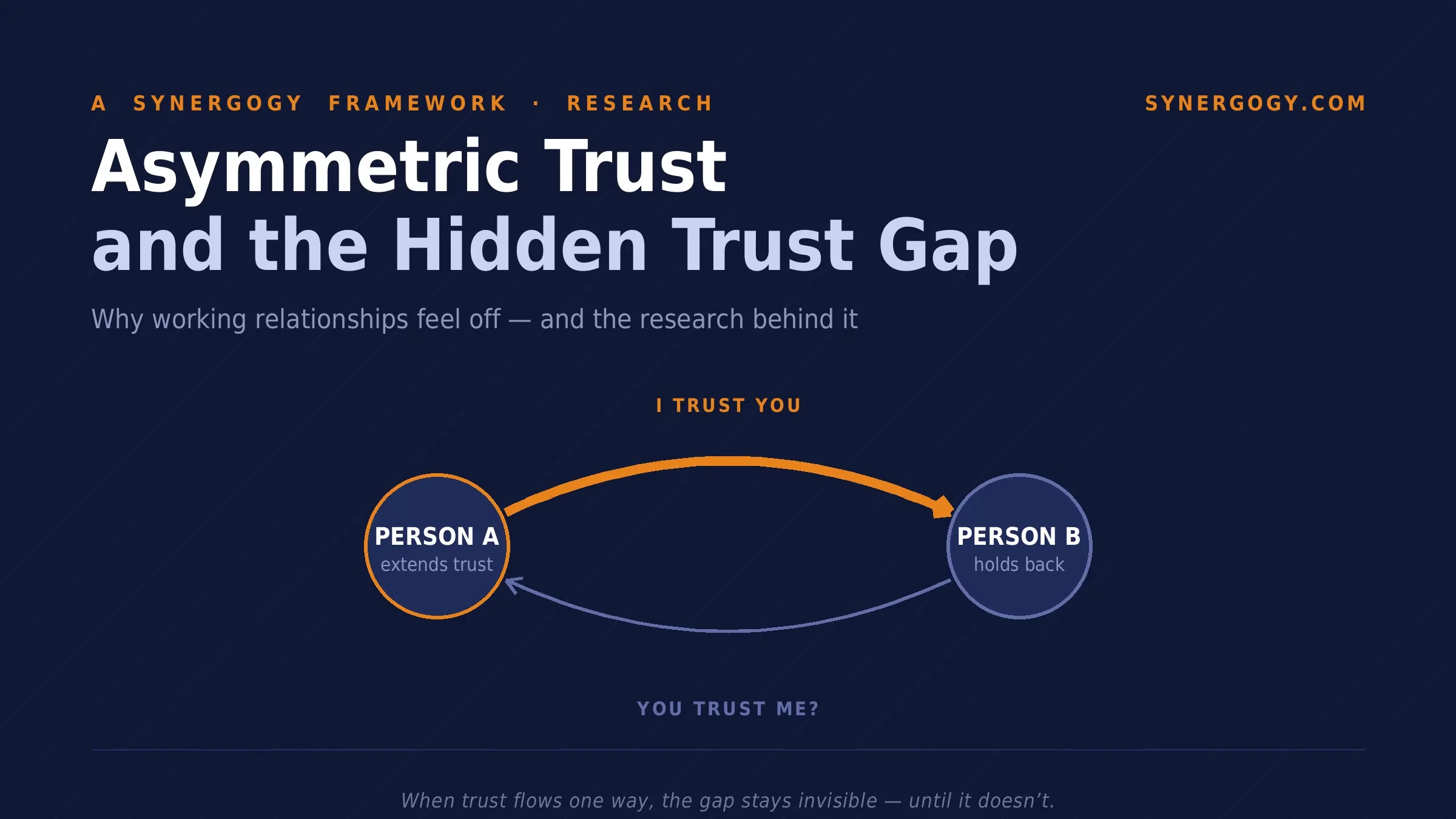
Asymmetric trust is the most consequential finding in modern trust research that almost no organisation acts upon. For decades, scholars and practitioners alike treated trust as a shared property of a relationship — either two people trust each other or they do not. Then a landmark review of dyadic trust shattered that assumption, showing that trust between two people frequently flows in unequal measure, creating a hidden trust gap that surveys never detect. The implications for organisational trust are profound, and nowhere more so than in trust between managers and employees, where the imbalance carries real costs in delegation, candour, and speed. This article unpacks the research behind asymmetric trust, explains why the dyadic trust gap stays invisible, and introduces the practitioner framework Synergogy built to close it.
The Assumption That Broke: Trust as a Shared Property
Classical models of organisational trust were built on a quietly convenient simplification. Mayer, Davis and Schoorman’s (1995) integrative model — still the most cited definition in the field — framed trust as one party’s willingness to be vulnerable to another based on perceived ability, benevolence, and integrity. The model was explicitly directional, yet in practice, researchers and HR teams measured trust as if it were a single shared score: “rate the trust in this relationship.” Consequently, organisational trust surveys averaged away the very signal that mattered most.
Lewicki, McAllister and Bies (1998) complicated the picture further by demonstrating that trust and distrust are separate constructs that can coexist within the same relationship. Meanwhile, experimental economists such as Berg, Dickhaut and McCabe (1995) showed through the now-famous investment game that trust extended and trust returned are empirically distinct behaviours. The evidence was accumulating: dyadic trust is not one number. It is two.
Korsgaard, Brower & Lester (2015): It Isn’t Always Mutual
The decisive synthesis arrived in the Journal of Management. In “It Isn’t Always Mutual: A Critical Review of Dyadic Trust”, Korsgaard, Brower and Lester (2015) reviewed the dyadic trust literature and reached a conclusion that should have changed management practice overnight: mutuality in trust is an empirical question, not a safe assumption. Their critical review distinguished three distinct phenomena that prior trust research had blurred together:
Three Forms of Dyadic Trust (after Korsgaard et al., 2015)
- Reciprocal trust — one party’s trust influences the other’s trust in return; trust as a dynamic exchange over time.
- Mutual trust — both parties hold a shared, comparably high level of trust in one another.
- Asymmetric trust — the parties hold different levels of trust in each other, and this difference itself shapes outcomes.
The third category is the revelation. Asymmetric trust is not merely a transitional state on the way to mutuality; it is a persistent, common, and consequential condition in working relationships. Furthermore, the review found that the consequences of asymmetric trust differ from those of simply “low trust” — an unequal trust distribution produces its own distinct dynamics, including misread intentions, mismatched risk-taking, and corrosive surprise when the imbalance is finally discovered.
Supporting evidence runs deep. Brower, Schoorman and Tan (2000) had already proposed a relational leadership model in which a manager’s trust in an employee and the employee’s trust in the manager are separate variables with separate consequences. Serva, Fuller and Mayer (2005) then demonstrated reciprocal trust spirals longitudinally between interacting teams: trusting action by one party begets trusting response from the other — which means an unreciprocated extension of trust eventually decays. Taken together, the literature converges on a single uncomfortable truth: the trust gap inside a pair is real, measurable, and routinely ignored.
Why the Dyadic Trust Gap Stays Invisible
If asymmetric trust is so common, why do leaders rarely see it? Three mechanisms keep the trust gap hidden.
Firstly, measurement averages it away. Engagement surveys ask employees whether they trust leadership, and 360° instruments ask raters whether they trust the subject. Each captures one direction; almost none compares the two directions within the same pair. As a result, a manager extending little trust to a highly trusting team scores identically to a genuinely mutual relationship. The asymmetry vanishes into the mean — precisely the methodological blind spot Korsgaard et al. (2015) identified in academic trust research itself.
Secondly, projection fills the gap. People tend to assume others trust them roughly as much as they trust others — a projection bias that makes one-sided trust feel mutual from the inside. The manager who withholds delegation while enjoying the team’s confidence rarely experiences the imbalance, because the cost lands on the other side of the desk.
Thirdly, politeness conceals the deficit. Trust between managers and employees operates under a power gradient. Employees who sense unequal trust rarely name it; instead they comply literally, share selectively, and verify quietly. The behavioural symptoms of asymmetric trust masquerade as ordinary professionalism — until a high-stakes moment exposes the gap.
Crucially, these mechanisms compound. The instrument cannot see the asymmetry, the leader cannot feel it, and the employee will not say it. Therefore, organisational trust initiatives keep treating a directional problem with non-directional remedies — values workshops, town halls, transparency pledges — and keep wondering why the needle barely moves.
What the Trust Gap Costs Organisations
The price of unmanaged asymmetric trust shows up in four ledgers. Delegation stalls, because a manager’s unextended trust caps how much responsibility actually transfers regardless of formal empowerment. Candour collapses, because the lower-trusting party filters what they share, starving decisions of accurate information. Speed suffers, because every unequal trust relationship adds verification loops — checking, witnessing, documenting — that mutual relationships simply skip. Finally, retention erodes: employees who extend trust upward without reciprocation eventually withdraw it, and the relationship slides from imbalance into mutual guardedness. In our organisation development diagnostics across the UAE, India, and beyond, these four costs surface so consistently that we now treat trust asymmetry as a leading indicator of execution risk, alongside the capability measures captured by our psychometric assessments.
From Research to Practice: The Missing 2×2
Here lies the genuine gap this article exists to name. Academia established asymmetric trust as a distinct, consequential construct over a decade ago. Yet practitioner tools never caught up. The popular trust frameworks — trust–agreement grids, trust equations, credibility matrices — all pair trust with a different variable. None of them maps the two directions of dyadic trust against each other in a form a leader can use on a whiteboard. The research said “measure both directions”; the toolkits kept measuring one.
Synergogy built the Trust Mirror™ to close exactly this gap. The Trust Mirror™ is a two-way matrix that plots “I trust you” against “you trust me”, converting the academic insight of Korsgaard et al. (2015) into four named, coachable relationship states. Two of those four states — the Exposure and the Custody — are pure asymmetric trust conditions that no single-axis tool can even represent. Each quadrant carries behavioural markers, Catalytic Questioning prompts for honest self-location, and a movement playbook grounded in the reciprocal trust dynamics Serva et al. (2005) documented: whoever moves first, moves the relationship.
In other words, the Trust Mirror™ is not another trust model competing for attention. It is the practitioner translation of a settled research finding — the bridge between what dyadic trust scholarship has known since 2015 and what leaders can act on this quarter. The full framework, with all four quadrants and movement strategies, is published here.
What Leaders Should Do Now
Begin with measurement that respects direction. For your five most critical working relationships, score both directions separately: how much do I trust this person, and how much evidence suggests they trust me? Honest scoring usually requires structured support — a 360° feedback tool to surface how your trust-extending behaviour actually lands, or an executive coaching conversation to challenge the projection bias that makes one-way trust feel mutual.
Next, locate each relationship on the Trust Mirror™ and apply the quadrant-specific strategy rather than a generic trust-building gesture. Asymmetric trust where you are the over-extender calls for verification before further extension; asymmetric trust where you are the withholder calls for visible reciprocation. Generic openness fixes neither. Equip your managers the same way: our coaching skills for managers programme and Micro Learning Labs™ convert the diagnostic into repeatable team practice, while DISC assessments reveal which behavioural style of trust-extension each person will read as genuine. Finally, re-map quarterly. Dyadic trust is dynamic; yesterday’s mutual relationship drifts under pressure, and the trust gap re-opens silently when leaders stop looking.
Why Synergogy for Closing the Trust Gap
Synergogy operates at the junction this article describes: rigorous behavioural science, translated into tools leaders actually use. Our leadership development programmes embed the Trust Mirror™ alongside evidence-based instruments, our workplace learning formats build trust diagnostics into manager enablement, and our consultants bring 27+ years of organisation development experience across 500+ organisations and 23+ industries. Whether the presenting problem is stalled delegation, guarded teams, or eroding trust between managers and employees, we start where the research says to start: with both directions of the dyad.
Suspect a trust gap is slowing your organisation down?
Frequently Asked Questions
What is asymmetric trust?
Asymmetric trust is a condition in which two parties in a working relationship hold different levels of trust in each other — one extends more than the other returns. Korsgaard, Brower and Lester (2015) identified it as a distinct, persistent, and consequential phenomenon in dyadic trust research, separate from both mutual trust and low trust.
How is asymmetric trust different from low trust?
Low trust means neither party extends much trust. Asymmetric trust means the trust is unequal — one side is exposed while the other withholds. Research shows the unequal condition produces its own dynamics, including misread intentions, mismatched risk-taking, and sudden relationship breakdown when the imbalance is discovered.
Why do engagement surveys miss the trust gap?
Standard surveys measure trust in one direction or average it into a single relationship score. Because asymmetric trust lives in the difference between two directions within the same pair, any instrument that captures only one direction — or averages the two — is structurally blind to it.
What is the Trust Mirror™ and how does it relate to this research?
The Trust Mirror™ is Synergogy’s two-way trust matrix that plots “I trust you” against “you trust me”, producing four named relationship states. It operationalises the asymmetric trust findings of Korsgaard et al. (2015) into a practical diagnostic with quadrant-specific movement strategies for leaders.
How can leaders detect asymmetric trust between managers and employees?
Look for directional symptoms: delegation that never fully transfers, polished but minimal upward communication, quiet verification behind backs, and politeness without depth. Structured 360° feedback and coached self-location on the Trust Mirror™ reveal which direction of the dyad is under-trusting.
References
Berg, J., Dickhaut, J., & McCabe, K. (1995). Trust, reciprocity, and social history. Games and Economic Behavior, 10(1), 122–142. https://doi.org/10.1006/game.1995.1027
Brower, H. H., Schoorman, F. D., & Tan, H. H. (2000). A model of relational leadership: The integration of trust and leader–member exchange. The Leadership Quarterly, 11(2), 227–250. https://doi.org/10.1016/S1048-9843(00)00040-0
Korsgaard, M. A., Brower, H. H., & Lester, S. W. (2015). It isn’t always mutual: A critical review of dyadic trust. Journal of Management, 41(1), 47–70. https://doi.org/10.1177/0149206314547521
Lewicki, R. J., McAllister, D. J., & Bies, R. J. (1998). Trust and distrust: New relationships and realities. Academy of Management Review, 23(3), 438–458. https://doi.org/10.5465/amr.1998.926620
Mayer, R. C., Davis, J. H., & Schoorman, F. D. (1995). An integrative model of organizational trust. Academy of Management Review, 20(3), 709–734. https://doi.org/10.5465/amr.1995.9508080335
Serva, M. A., Fuller, M. A., & Mayer, R. C. (2005). The reciprocal nature of trust: A longitudinal study of interacting teams. Journal of Organizational Behavior, 26(6), 625–648. https://doi.org/10.1002/job.331
Founder & CEO, OKR International & Synergogy
Nikhil Maini is an international keynote speaker, organisation development consultant, and creator of the Trust Mirror™. Over 27+ years he has advised 500+ organisations across 23+ industries on execution, leadership, and culture — translating behavioural science research into frameworks leaders actually use. He is a member of the Forbes Business Council and works with boards and executive teams across the UAE, India, and globally.